Independent writing on tax-smart planning, mortgage strategy, and retirement building. For Canadian professionals who want the whole picture, not just a piece of it.
Carney's Investment Pitch Collides With a 50% Tariff on Canadian Exports
Mark Carney will stand before the world's largest pension funds and sovereign wealth managers in Toronto, September 14-15, 2026, making the case for Canada as a stable, productive home for capital. Roughly two-thirds of the country's institutional investors currently hold the majority of their assets outside Canadian borders. The timing is awkward. The U.S. government has imposed a 50% tariff on certain Canadian imports as of August 2026, disrupting the trade relationship that accounts for 75.9% of Canadian exports, according to the United States Trade Representative.
The investment summit Carney is convening focuses on what the federal government calls "future-economy" sectors: artificial intelligence factories and data centers, critical mineral extraction, and clean energy transition projects. These are capital-intensive bets that require long-term stability. The tariff environment offers the opposite. USMCA, the trilateral trade agreement that governs North American commerce, began its mandatory joint review on July 1, 2026. Until that process concludes, institutional allocators face uncertainty about whether supply chains anchored in Canada will remain viable or require costly reconfiguration.
Why capital stayed out before the tariffs hit
Canadian pension funds have been net exporters of capital for years, a trend unrelated to recent trade friction. The calculus is simple. U.S. equity markets are deeper, more liquid, and have historically delivered higher returns than domestic alternatives. Emerging markets offer growth that Canada's mature resource and financial sectors cannot match. A fund manager's duty to beneficiaries means maximizing returns regardless of national industrial policy. The government's frustration with this dynamic predates Carney's involvement, but he has taken on the task of reversing it.
The pitch relies on two premises. First, that geopolitical instability elsewhere makes Canada a comparatively safe jurisdiction. Second, that federal incentives, tax credits for green technology, streamlined permitting for mines, co-investment vehicles for AI, can narrow the return gap enough to shift allocations. Both premises now compete with a harder fact: goods produced in Canada and sold into the U.S. face a 50% markup at the border, rendering some export-oriented projects uneconomical before the first dollar is deployed.
The dual exposure problem
Canada positions itself as insulated from the chaos driving capital out of other regions. That framing worked when the chaos was overseas. When the source of uncertainty is the country's largest trading partner, proximity becomes a liability rather than a buffer. A semiconductor plant in Ontario looks stable relative to one in Southeast Asia, until you model the revenue impact of tariffs that erase margin on every chip sold south. The roads, power grids, and buildings are sound. The ports and shipping routes to U.S. buyers are blocked.
Carney's role adds a layer of complexity. As a former central banker with credibility in global finance, he can open doors. As a potential political candidate, his involvement ties the summit to partisan positioning ahead of an election. Investors parsing risk typically prefer separation between policymaking and campaign optics. The summit blurs that line.
Canada announced retaliatory tariffs worth C$15.6 billion as of March 2026, according to the Congressional Research Service. That figure represents goods already subject to countermeasures, with a planned expansion to C$155 billion outlined by the Government of Canada in early 2025. Retaliation signals resolve but does not restore the conditions investors require. It raises costs on both sides and extends the timeline before trade normalizes.
The summit will surface commitments. Pension funds may pledge allocations to Canadian roads, mines, power plants, and semiconductor fabs. The question is execution. A pledge to invest in Canada while tariffs persist is a bet that the trade war resolves before the capital is deployed. That is a political forecast dressed as an investment decision.


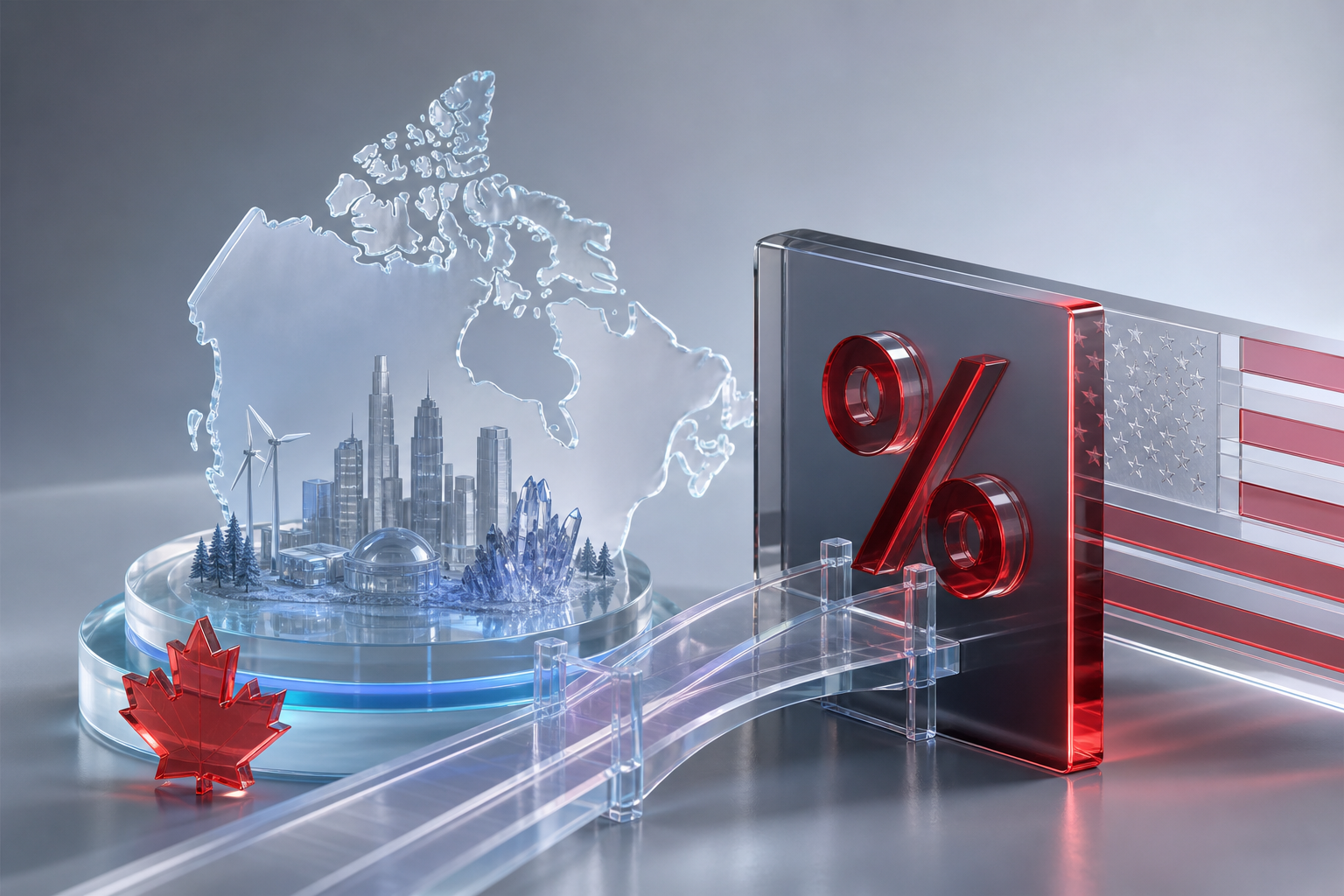

Mark Carney will stand before the world's largest pension funds and sovereign wealth managers in Toronto, September 14-15, 2026, making the case for Canada as a stable, productive home for capital. Roughly two-thirds of the country's institutional investors currently hold the majority of their assets outside Canadian borders. The timing is awkward. The U.S. government has imposed a 50% tariff on certain Canadian imports as of August 2026, disrupting the trade relationship that accounts for 75.9% of Canadian exports, according to the United States Trade Representative.
The investment summit Carney is convening focuses on what the federal government calls "future-economy" sectors: artificial intelligence factories and data centers, critical mineral extraction, and clean energy transition projects. These are capital-intensive bets that require long-term stability. The tariff environment offers the opposite. USMCA, the trilateral trade agreement that governs North American commerce, began its mandatory joint review on July 1, 2026. Until that process concludes, institutional allocators face uncertainty about whether supply chains anchored in Canada will remain viable or require costly reconfiguration.
Why capital stayed out before the tariffs hit
Canadian pension funds have been net exporters of capital for years, a trend unrelated to recent trade friction. The calculus is simple. U.S. equity markets are deeper, more liquid, and have historically delivered higher returns than domestic alternatives. Emerging markets offer growth that Canada's mature resource and financial sectors cannot match. A fund manager's duty to beneficiaries means maximizing returns regardless of national industrial policy. The government's frustration with this dynamic predates Carney's involvement, but he has taken on the task of reversing it.
The pitch relies on two premises. First, that geopolitical instability elsewhere makes Canada a comparatively safe jurisdiction. Second, that federal incentives, tax credits for green technology, streamlined permitting for mines, co-investment vehicles for AI, can narrow the return gap enough to shift allocations. Both premises now compete with a harder fact: goods produced in Canada and sold into the U.S. face a 50% markup at the border, rendering some export-oriented projects uneconomical before the first dollar is deployed.
The dual exposure problem
Canada positions itself as insulated from the chaos driving capital out of other regions. That framing worked when the chaos was overseas. When the source of uncertainty is the country's largest trading partner, proximity becomes a liability rather than a buffer. A semiconductor plant in Ontario looks stable relative to one in Southeast Asia, until you model the revenue impact of tariffs that erase margin on every chip sold south. The roads, power grids, and buildings are sound. The ports and shipping routes to U.S. buyers are blocked.
Carney's role adds a layer of complexity. As a former central banker with credibility in global finance, he can open doors. As a potential political candidate, his involvement ties the summit to partisan positioning ahead of an election. Investors parsing risk typically prefer separation between policymaking and campaign optics. The summit blurs that line.
Canada announced retaliatory tariffs worth C$15.6 billion as of March 2026, according to the Congressional Research Service. That figure represents goods already subject to countermeasures, with a planned expansion to C$155 billion outlined by the Government of Canada in early 2025. Retaliation signals resolve but does not restore the conditions investors require. It raises costs on both sides and extends the timeline before trade normalizes.
The summit will surface commitments. Pension funds may pledge allocations to Canadian roads, mines, power plants, and semiconductor fabs. The question is execution. A pledge to invest in Canada while tariffs persist is a bet that the trade war resolves before the capital is deployed. That is a political forecast dressed as an investment decision.
Sources
Read Next
A Small Cut to 0.9% Growth Points to Canada's Longer Problem
Ottawa Already Holds the Income Data That Could Curb Mortgage Fraud
Ferries, Septic and Storm Insurance: What a Vancouver Island Cottage Really Costs Yearly
Six Bulk Buyers Took 339 Toronto Condos at 40% Off: Their Risk Checklist