Independent writing on tax-smart planning, mortgage strategy, and retirement building. For Canadian professionals who want the whole picture, not just a piece of it.
Retaliatory tariffs feel good until they hit Canadian wallets
Canada announced C$27.6 billion in countermeasures on American goods in August 2026, targeting bourbon, orange juice, and Harley-Davidsons. The move played well in Ottawa press conferences and satisfied voters who wanted to see someone punch back. What it actually accomplished was shifting more of the tariff burden onto Canadian households already dealing with mortgage renewals in the low-4% range and grocery bills that haven't come down since 2023.
The arithmetic is straightforward. When Canada slaps a 50% surcharge on U.S. steel, the price increase lands on Canadian manufacturers buying that steel, not American exporters. A fabricator in Hamilton sourcing structural beams for a condo project now pays more, which means the project costs more, which means rents go higher or the project doesn't pencil. The U.S. steel mill is unaffected. It sells domestically or finds another buyer. The Canadian end-user absorbs the tariff as a tax.
The asymmetry nobody wants to admit
The entire trade relationship runs through this asymmetry. About 72% of Canadian merchandise exports went to the United States in 2025, down from nearly 76% the year before. For the U.S., Canada represents about 15% of its export market. When both countries impose matching tariffs, the disruption is not evenly distributed. A Michigan auto-parts plant loses one customer; an Ontario supplier loses its entire order book. That difference shows up in employment numbers, capacity utilization, and eventually provincial revenues.
This isn't an argument against all retaliation. There are moments when failing to respond signals weakness and invites further escalation. The 2018 steel and aluminum dispute, where Canada applied tariffs on C$15.6 billion of U.S. imports, was one of those moments. The political cost of doing nothing would have been destabilizing. But the economic cost of doing something was also real. Canadian consumers paid higher prices on affected goods for two years, and the U.S. administration barely noticed.
The deeper problem is that Canada has spent decades optimizing for frictionless trade with a partner that no longer values frictionless trade. The WTO dispute-resolution system, which used to provide some institutional protection for mid-sized economies, has been effectively gutted. What remains is power-based negotiation. In power-based negotiation, the country with the larger domestic market and the lower dependency ratio wins.
What indispensability actually looks like
If Canada cannot win a tariff fight on price, it has to win on irreplaceability. That means doubling down on the inputs the U.S. cannot easily source elsewhere: critical minerals for EV batteries, secure energy supply, and specialized manufacturing components that cross the border multiple times before final assembly. The automotive and aerospace sectors, where supply chains are most tightly integrated, represent the best leverage Canada has. A 10% tariff that disrupts just-in-time delivery in Michigan matters more to a U.S. legislator than a 50% tariff on bourbon matters to a Kentucky distiller.
But making yourself indispensable requires investment in domestic capacity, not trade barriers. Business investment in machinery and equipment grew just 2.3% in Q2 2026, a figure that barely covers depreciation. If Canadian manufacturers cannot produce high-value, hard-to-replace goods, they have nothing to negotiate with except access to the Canadian consumer market. That market is approximately 41 million people. The U.S. market is 349 million. The negotiating position writes itself.
The CUSMA review lands in 2026. Both sides will confirm, in writing, whether the agreement continues for another 16 years. If Canada enters that negotiation having spent two years in a tit-for-tat tariff spiral, the U.S. position will be: concede more or we let it expire. If Canada enters that negotiation as an indispensable supplier of inputs the U.S. green economy depends on, the conversation changes.
Retaliatory tariffs serve one constituency well: the voting public that wants to see fight. They serve the Canadian economy poorly. The gap between those two outcomes is what makes trade policy so hard to get right.


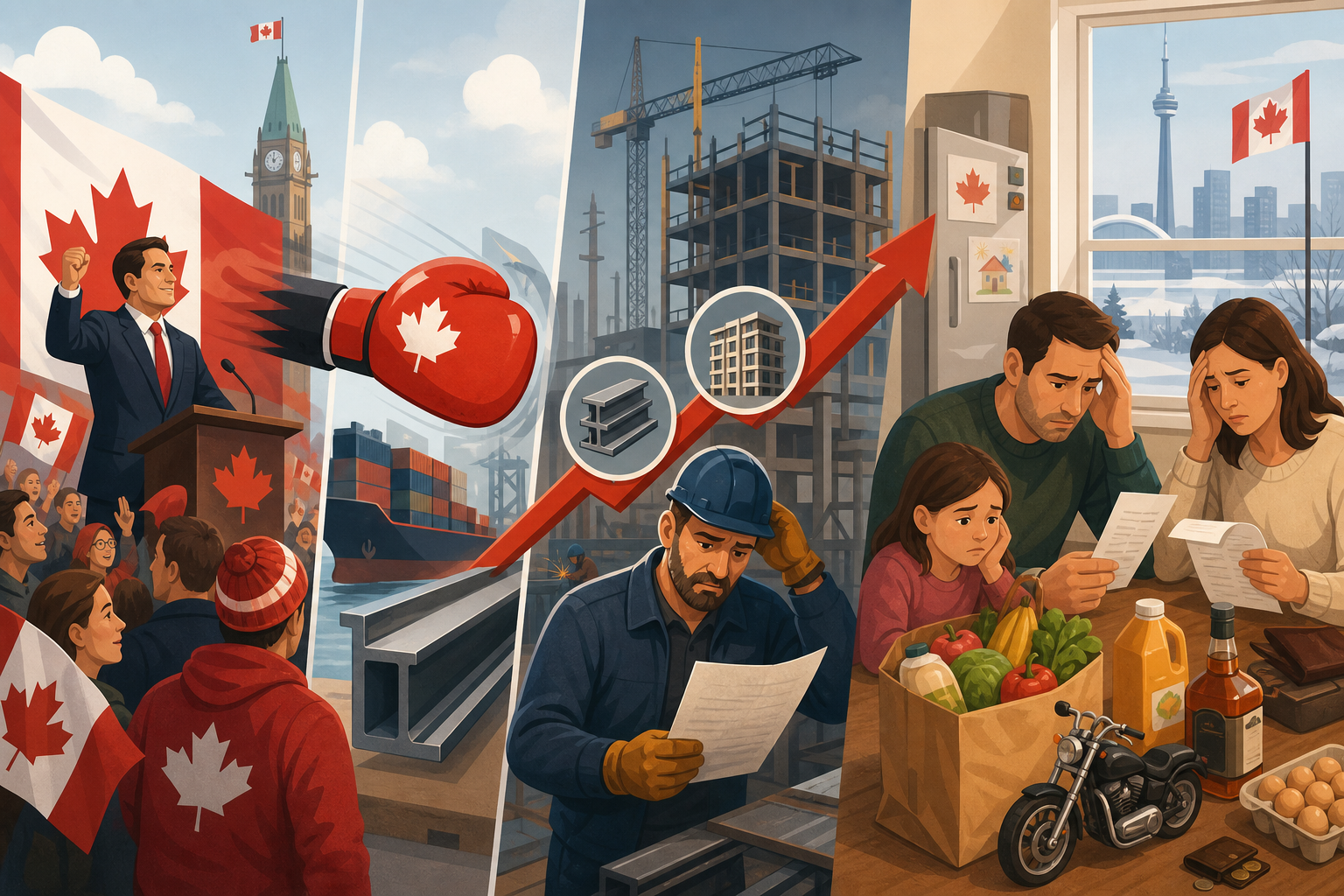

Canada announced C$27.6 billion in countermeasures on American goods in August 2026, targeting bourbon, orange juice, and Harley-Davidsons. The move played well in Ottawa press conferences and satisfied voters who wanted to see someone punch back. What it actually accomplished was shifting more of the tariff burden onto Canadian households already dealing with mortgage renewals in the low-4% range and grocery bills that haven't come down since 2023.
The arithmetic is straightforward. When Canada slaps a 50% surcharge on U.S. steel, the price increase lands on Canadian manufacturers buying that steel, not American exporters. A fabricator in Hamilton sourcing structural beams for a condo project now pays more, which means the project costs more, which means rents go higher or the project doesn't pencil. The U.S. steel mill is unaffected. It sells domestically or finds another buyer. The Canadian end-user absorbs the tariff as a tax.
The asymmetry nobody wants to admit
The entire trade relationship runs through this asymmetry. About 72% of Canadian merchandise exports went to the United States in 2025, down from nearly 76% the year before. For the U.S., Canada represents about 15% of its export market. When both countries impose matching tariffs, the disruption is not evenly distributed. A Michigan auto-parts plant loses one customer; an Ontario supplier loses its entire order book. That difference shows up in employment numbers, capacity utilization, and eventually provincial revenues.
This isn't an argument against all retaliation. There are moments when failing to respond signals weakness and invites further escalation. The 2018 steel and aluminum dispute, where Canada applied tariffs on C$15.6 billion of U.S. imports, was one of those moments. The political cost of doing nothing would have been destabilizing. But the economic cost of doing something was also real. Canadian consumers paid higher prices on affected goods for two years, and the U.S. administration barely noticed.
The deeper problem is that Canada has spent decades optimizing for frictionless trade with a partner that no longer values frictionless trade. The WTO dispute-resolution system, which used to provide some institutional protection for mid-sized economies, has been effectively gutted. What remains is power-based negotiation. In power-based negotiation, the country with the larger domestic market and the lower dependency ratio wins.
What indispensability actually looks like
If Canada cannot win a tariff fight on price, it has to win on irreplaceability. That means doubling down on the inputs the U.S. cannot easily source elsewhere: critical minerals for EV batteries, secure energy supply, and specialized manufacturing components that cross the border multiple times before final assembly. The automotive and aerospace sectors, where supply chains are most tightly integrated, represent the best leverage Canada has. A 10% tariff that disrupts just-in-time delivery in Michigan matters more to a U.S. legislator than a 50% tariff on bourbon matters to a Kentucky distiller.
But making yourself indispensable requires investment in domestic capacity, not trade barriers. Business investment in machinery and equipment grew just 2.3% in Q2 2026, a figure that barely covers depreciation. If Canadian manufacturers cannot produce high-value, hard-to-replace goods, they have nothing to negotiate with except access to the Canadian consumer market. That market is approximately 41 million people. The U.S. market is 349 million. The negotiating position writes itself.
The CUSMA review lands in 2026. Both sides will confirm, in writing, whether the agreement continues for another 16 years. If Canada enters that negotiation having spent two years in a tit-for-tat tariff spiral, the U.S. position will be: concede more or we let it expire. If Canada enters that negotiation as an indispensable supplier of inputs the U.S. green economy depends on, the conversation changes.
Retaliatory tariffs serve one constituency well: the voting public that wants to see fight. They serve the Canadian economy poorly. The gap between those two outcomes is what makes trade policy so hard to get right.
Sources
Read Next
A Small Cut to 0.9% Growth Points to Canada's Longer Problem
Ottawa Already Holds the Income Data That Could Curb Mortgage Fraud
Ferries, Septic and Storm Insurance: What a Vancouver Island Cottage Really Costs Yearly
Six Bulk Buyers Took 339 Toronto Condos at 40% Off: Their Risk Checklist