Independent writing on tax-smart planning, mortgage strategy, and retirement building. For Canadian professionals who want the whole picture, not just a piece of it.
Canada faces up to 87,000 lost jobs and 0.3-0.6% GDP drop under new U.S. tariffs
The 50 per cent tariff announced last month landed hardest on a steel fabrication plant in Hamilton that ships precision-cut components to Michigan assembly lines three times a week. The owner told CBC the math was immediate: a $12,000 shipment now costs the customer $18,000 at the border, and the customer has already started sourcing domestically. That single contract supported four full-time positions.
Scale that scenario across the roughly $430 billion in annual merchandise exports Canada sends to the U.S., and the arithmetic becomes national. TD Economics projects a sustained tariff environment at current levels would remove 0.3 to 0.6 percentage points from Canada's real GDP growth over the next year. For a $2.5 trillion economy, that translates to roughly $8 billion to $15 billion CAD in foregone output. University of Calgary economist Trevor Tombe estimates total job losses of roughly 87,000, with 52,000 in affected sectors and 35,000 in supporting industries, depending on how long the tariffs stay in place and whether exemptions materialize for key sectors.
Why the manufacturing heartland absorbs most of the hit
The automotive sector illustrates the vulnerability. A single vehicle crosses the Canada-U.S. border an average of seven times during production as parts move between suppliers and assembly plants. Each crossing is now a taxable event. A $2,000 component taxed at 50 per cent becomes $3,000. If that component crosses twice more before final assembly, the compounding cost can push the vehicle's production budget above what the market will bear. Ford and Stellantis have both flagged temporary line slowdowns in Ontario plants while they re-route supply chains, and each slowdown is measured in hundreds of jobs per facility.
Steel and aluminum face explicit 50 per cent levies under the renewed Section 232 national security provisions, the same legal mechanism used in 2018. At that time, Canada responded with C$16.6 billion in retaliatory tariffs on U.S. goods, targeting politically symbolic products: bourbon from Kentucky, yogurt from Wisconsin, orange juice from Florida. This round, Global Affairs Canada has prepared a list covering C$155 billion in potential countermeasures, though the government has so far held off implementing the full package, likely waiting to see whether exemptions emerge through negotiation.
The currency and inflation feedback loop
A weaker Canadian dollar typically cushions export shocks by making Canadian goods cheaper in U.S. dollar terms. The loonie has dropped to around $0.71 USD in recent weeks, which would normally offset a 10 per cent tariff. It does not offset a 50 per cent tariff. And the depreciation creates a second problem: imported machinery, technology, and intermediate goods all cost more, which feeds input cost inflation back into the manufacturing base the currency move was supposed to protect.
Bank of Canada Governor Tiff Macklem noted in a July speech that external tariff shocks complicate the inflation-targeting mandate because they are simultaneously deflationary (reduced demand, lower growth) and inflationary (higher input costs). The central bank cannot cut rates to stimulate growth without risking a reacceleration of consumer price growth from import costs.
Energy exports, which represent the largest dollar value in the Canada-U.S. trade relationship, have historically been the last sector targeted in trade disputes. U.S. refineries along the Gulf Coast are configured specifically for heavy Canadian crude, and there is no near-term substitute at the volumes required. If tariffs eventually extend to oil and gas, the GDP impact would move well past 0.3 to 0.6 percentage points.
The 2026 CUSMA review sits nine months out. Both governments understand the current tariff posture violates treaty obligations. What neither can predict is whether the negotiation to resolve it happens before or after tens of thousands of workers lose their positions.


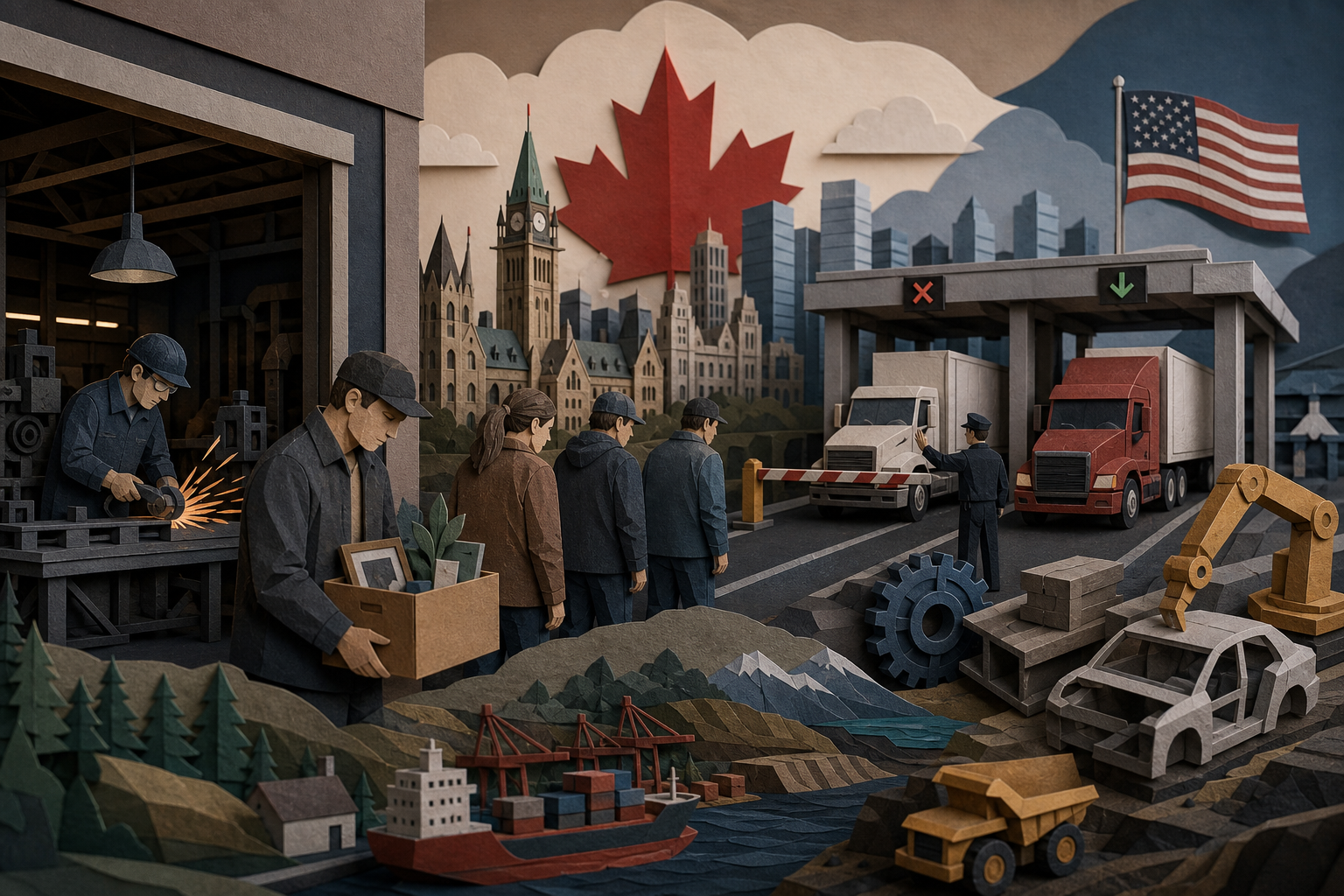

The 50 per cent tariff announced last month landed hardest on a steel fabrication plant in Hamilton that ships precision-cut components to Michigan assembly lines three times a week. The owner told CBC the math was immediate: a $12,000 shipment now costs the customer $18,000 at the border, and the customer has already started sourcing domestically. That single contract supported four full-time positions.
Scale that scenario across the roughly $430 billion in annual merchandise exports Canada sends to the U.S., and the arithmetic becomes national. TD Economics projects a sustained tariff environment at current levels would remove 0.3 to 0.6 percentage points from Canada's real GDP growth over the next year. For a $2.5 trillion economy, that translates to roughly $8 billion to $15 billion CAD in foregone output. University of Calgary economist Trevor Tombe estimates total job losses of roughly 87,000, with 52,000 in affected sectors and 35,000 in supporting industries, depending on how long the tariffs stay in place and whether exemptions materialize for key sectors.
Why the manufacturing heartland absorbs most of the hit
The automotive sector illustrates the vulnerability. A single vehicle crosses the Canada-U.S. border an average of seven times during production as parts move between suppliers and assembly plants. Each crossing is now a taxable event. A $2,000 component taxed at 50 per cent becomes $3,000. If that component crosses twice more before final assembly, the compounding cost can push the vehicle's production budget above what the market will bear. Ford and Stellantis have both flagged temporary line slowdowns in Ontario plants while they re-route supply chains, and each slowdown is measured in hundreds of jobs per facility.
Steel and aluminum face explicit 50 per cent levies under the renewed Section 232 national security provisions, the same legal mechanism used in 2018. At that time, Canada responded with C$16.6 billion in retaliatory tariffs on U.S. goods, targeting politically symbolic products: bourbon from Kentucky, yogurt from Wisconsin, orange juice from Florida. This round, Global Affairs Canada has prepared a list covering C$155 billion in potential countermeasures, though the government has so far held off implementing the full package, likely waiting to see whether exemptions emerge through negotiation.
The currency and inflation feedback loop
A weaker Canadian dollar typically cushions export shocks by making Canadian goods cheaper in U.S. dollar terms. The loonie has dropped to around $0.71 USD in recent weeks, which would normally offset a 10 per cent tariff. It does not offset a 50 per cent tariff. And the depreciation creates a second problem: imported machinery, technology, and intermediate goods all cost more, which feeds input cost inflation back into the manufacturing base the currency move was supposed to protect.
Bank of Canada Governor Tiff Macklem noted in a July speech that external tariff shocks complicate the inflation-targeting mandate because they are simultaneously deflationary (reduced demand, lower growth) and inflationary (higher input costs). The central bank cannot cut rates to stimulate growth without risking a reacceleration of consumer price growth from import costs.
Energy exports, which represent the largest dollar value in the Canada-U.S. trade relationship, have historically been the last sector targeted in trade disputes. U.S. refineries along the Gulf Coast are configured specifically for heavy Canadian crude, and there is no near-term substitute at the volumes required. If tariffs eventually extend to oil and gas, the GDP impact would move well past 0.3 to 0.6 percentage points.
The 2026 CUSMA review sits nine months out. Both governments understand the current tariff posture violates treaty obligations. What neither can predict is whether the negotiation to resolve it happens before or after tens of thousands of workers lose their positions.
Sources
Read Next
A Small Cut to 0.9% Growth Points to Canada's Longer Problem
Ottawa Already Holds the Income Data That Could Curb Mortgage Fraud
Ferries, Septic and Storm Insurance: What a Vancouver Island Cottage Really Costs Yearly
Six Bulk Buyers Took 339 Toronto Condos at 40% Off: Their Risk Checklist