Independent writing on tax-smart planning, mortgage strategy, and retirement building. For Canadian professionals who want the whole picture, not just a piece of it.
Canada's Counter-Tariffs Look Like Strength but Deliver Economic Self-Harm
Canada's Counter-Tariffs Look Like Strength but Deliver Economic Self-Harm
Ottawa's C$15.6 billion retaliatory tariff package, announced in March 2026, targets 155 American products ranging from Florida orange juice to Kentucky bourbon. The list reads like a political map of swing states. It was designed that way on purpose.
The federal government calls this "proportional response." Finance officials describe the measure as surgical retaliation intended to pressure U.S. lawmakers without collapsing supply chains. What they don't say is that every dollar of tariff revenue collected at the border comes from a Canadian business writing the check, not an American one.
The mechanics work backward
Tariffs function as a tax on imports. When Canada places a 25% duty on U.S. dairy products, the Canadian dairy processor importing American cream pays that fee to the Canada Border Services Agency. The processor then passes the cost to the retailer. The retailer passes it to the consumer. The American supplier sees no invoice from Ottawa. Their price to the Canadian buyer simply becomes uncompetitive, so the volume drops.
That might sound like effective punishment until you realize what happens next. Roughly 80% of Canadian manufacturing exports are integrated into U.S. supply chains, particularly in the Great Lakes automotive corridor where components cross the border five to seven times before a finished vehicle rolls off the line. A tariff at any stage compounds costs at every subsequent stage. When Canada taxes U.S. intermediate goods, it raises the input cost for its own manufacturers, who then ship higher-priced components back south, triggering reciprocal cost increases in the U.S. plants they supply.
The economic term for this is "vertical integration exposure." The plain language version is that we're taxing ourselves.
The inflation problem nobody mentions
Canada entered 2026 with inflation sticky above the Bank of Canada's 2% target. Housing costs remain elevated. Grocery prices haven't meaningfully retreated from their 2024 peaks. Counter-tariffs on consumer goods act as a regressive tax in that environment. When the government places a duty on U.S. household paper products or yogurt, both appeared on past retaliation lists, the cost burden falls hardest on lower-income households that spend the highest share of income on consumables.
The political logic is to create voter pressure in targeted U.S. congressional districts. The economic reality is that Canadian households absorb the price increase while the Bank of Canada faces a policy dilemma: raise rates to cool inflation the government itself just stoked, or hold steady and let price pressures build.
What the alternative actually requires
The counterargument goes like this: failing to retaliate invites further bullying and signals Canada is a soft target. There's truth in that. Doing nothing after a provocation creates moral hazard. But the choice isn't binary between broad tariffs and capitulation.
Canada could pursue sector-specific exemptions through CUSMA dispute mechanisms rather than blanket retaliation. It could accelerate export diversification to CPTPP and CETA markets, reducing the 75% U.S. dependency that makes every trade spat asymmetric. It could target tariffs on American government contracting rules, regulations on product safety and environmental standards, and permits for border infrastructure projects, rather than measures that directly tax Canadian consumers.
Those moves take years. Retaliatory tariff lists can be drafted in weeks, announced with a press conference, and framed as strength to a domestic electorate tired of being pushed around. The optics work. The economics don't.
The C$15.6 billion figure represents goods Canada is now taxing itself to import. Every press release calls it leverage. Every invoice calls it a cost.


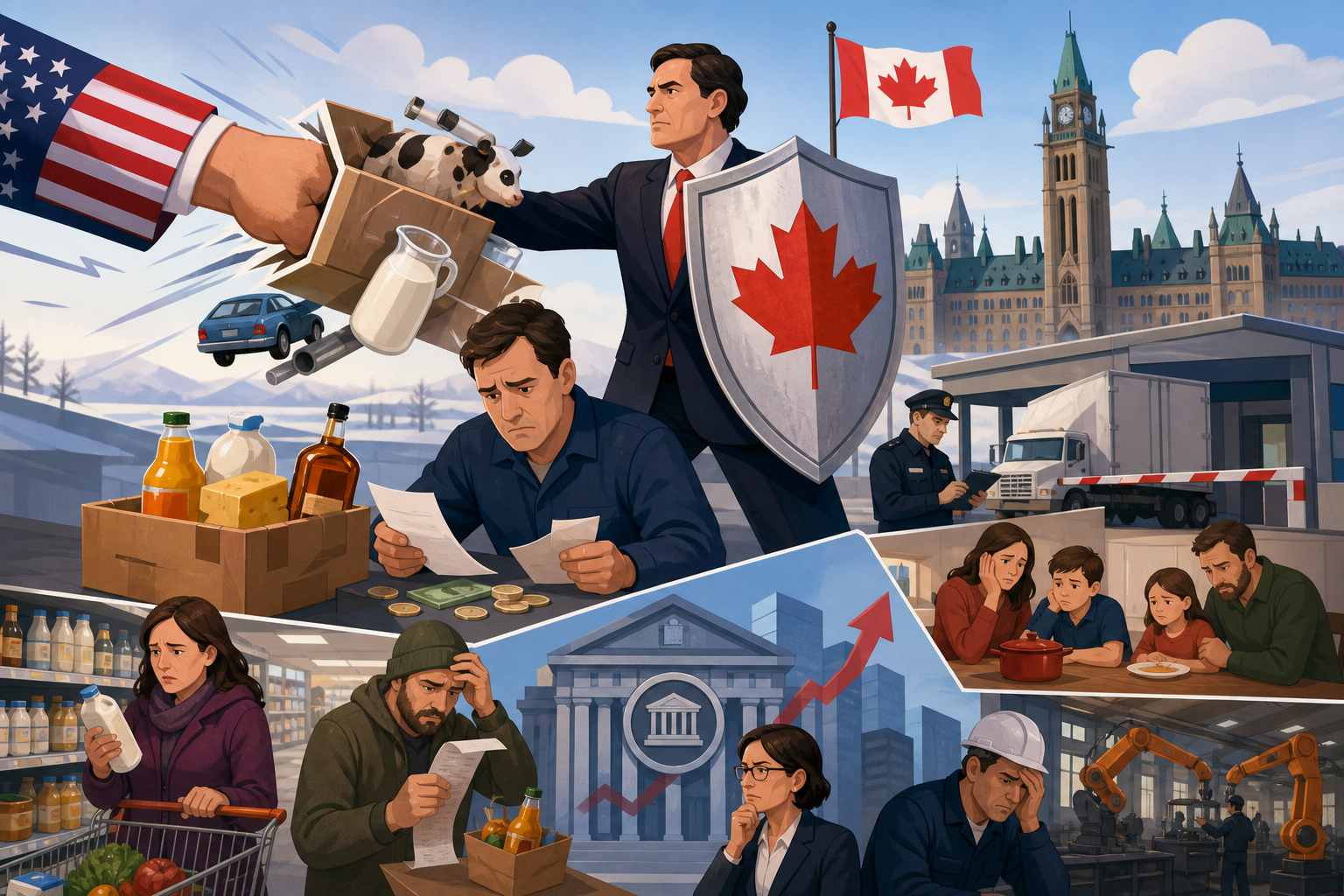

Canada's Counter-Tariffs Look Like Strength but Deliver Economic Self-Harm
Ottawa's C$15.6 billion retaliatory tariff package, announced in March 2026, targets 155 American products ranging from Florida orange juice to Kentucky bourbon. The list reads like a political map of swing states. It was designed that way on purpose.
The federal government calls this "proportional response." Finance officials describe the measure as surgical retaliation intended to pressure U.S. lawmakers without collapsing supply chains. What they don't say is that every dollar of tariff revenue collected at the border comes from a Canadian business writing the check, not an American one.
The mechanics work backward
Tariffs function as a tax on imports. When Canada places a 25% duty on U.S. dairy products, the Canadian dairy processor importing American cream pays that fee to the Canada Border Services Agency. The processor then passes the cost to the retailer. The retailer passes it to the consumer. The American supplier sees no invoice from Ottawa. Their price to the Canadian buyer simply becomes uncompetitive, so the volume drops.
That might sound like effective punishment until you realize what happens next. Roughly 80% of Canadian manufacturing exports are integrated into U.S. supply chains, particularly in the Great Lakes automotive corridor where components cross the border five to seven times before a finished vehicle rolls off the line. A tariff at any stage compounds costs at every subsequent stage. When Canada taxes U.S. intermediate goods, it raises the input cost for its own manufacturers, who then ship higher-priced components back south, triggering reciprocal cost increases in the U.S. plants they supply.
The economic term for this is "vertical integration exposure." The plain language version is that we're taxing ourselves.
The inflation problem nobody mentions
Canada entered 2026 with inflation sticky above the Bank of Canada's 2% target. Housing costs remain elevated. Grocery prices haven't meaningfully retreated from their 2024 peaks. Counter-tariffs on consumer goods act as a regressive tax in that environment. When the government places a duty on U.S. household paper products or yogurt, both appeared on past retaliation lists, the cost burden falls hardest on lower-income households that spend the highest share of income on consumables.
The political logic is to create voter pressure in targeted U.S. congressional districts. The economic reality is that Canadian households absorb the price increase while the Bank of Canada faces a policy dilemma: raise rates to cool inflation the government itself just stoked, or hold steady and let price pressures build.
What the alternative actually requires
The counterargument goes like this: failing to retaliate invites further bullying and signals Canada is a soft target. There's truth in that. Doing nothing after a provocation creates moral hazard. But the choice isn't binary between broad tariffs and capitulation.
Canada could pursue sector-specific exemptions through CUSMA dispute mechanisms rather than blanket retaliation. It could accelerate export diversification to CPTPP and CETA markets, reducing the 75% U.S. dependency that makes every trade spat asymmetric. It could target tariffs on American government contracting rules, regulations on product safety and environmental standards, and permits for border infrastructure projects, rather than measures that directly tax Canadian consumers.
Those moves take years. Retaliatory tariff lists can be drafted in weeks, announced with a press conference, and framed as strength to a domestic electorate tired of being pushed around. The optics work. The economics don't.
The C$15.6 billion figure represents goods Canada is now taxing itself to import. Every press release calls it leverage. Every invoice calls it a cost.
Read Next
A Small Cut to 0.9% Growth Points to Canada's Longer Problem
Ottawa Already Holds the Income Data That Could Curb Mortgage Fraud
Ferries, Septic and Storm Insurance: What a Vancouver Island Cottage Really Costs Yearly
Six Bulk Buyers Took 339 Toronto Condos at 40% Off: Their Risk Checklist