Independent writing on tax-smart planning, mortgage strategy, and retirement building. For Canadian professionals who want the whole picture, not just a piece of it.
Why a Military Drone Contract Could Send This TSX Small-Cap Higher
TD Cowen published its Canadian small-cap picks this week with an unusual level of conviction. Drone Delivery Canada sits at the top, carrying a 2026 price target that implies 59% upside from current levels. The thesis rests on a single contract: a contract from the Canadian Armed Forces for heavy-lift drone hardware and logistics support in remote operational zones.
The figure matters less for its size than for what it validates. Industrial drones have been marketed as cost savers for years, but the technology has faced a credibility problem. Cold weather performance, payload reliability, and regulatory approval for autonomous flight beyond visual line of sight have all been theoretical until someone writes the cheque. The CAF contract is that cheque.
The dual-use economics that changed the model
Drone Delivery Canada's platform was originally positioned for commercial use: last-mile deliveries to mining camps, fly-in communities, and remote supply routes in the North. The challenge was always the initial capital cost. A single industrial drone capable of carrying 400 kilograms costs roughly what a used Cessna 208 Caravan does, and the Caravan has 70 years of field data behind it.
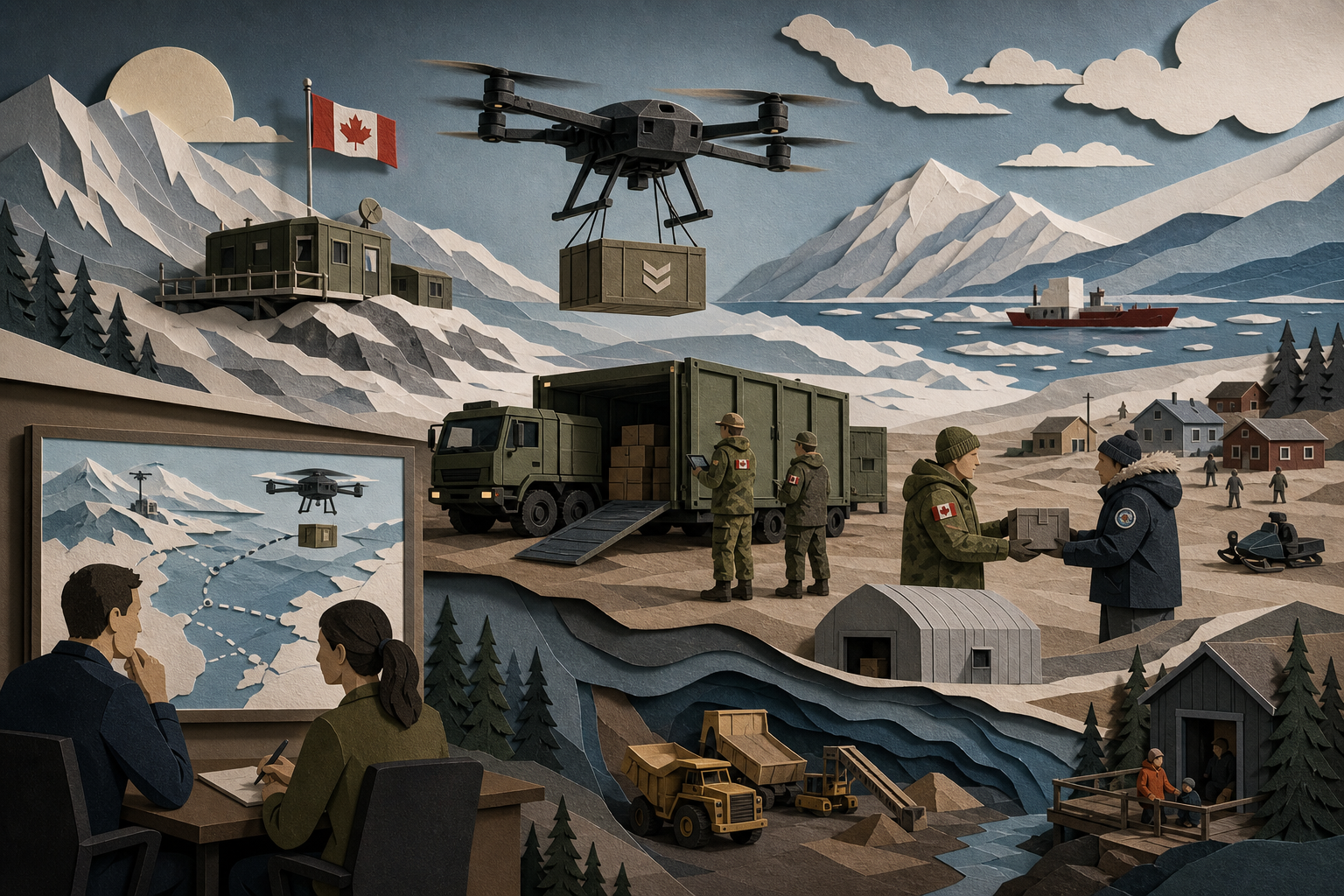
What shifted the calculation was dual-use deployment. The CAF needs a logistics solution that works in the High Arctic without the carbon cost or operational complexity of piloted aircraft. A drone route between a Forward Operating Base and a supply depot 600 kilometres north can run autonomously in conditions that ground helicopters for weeks. The same hardware, once proven in military trials, becomes viable for civilian operators who need the same capability but couldn't justify the risk alone.
The contract funds the proving phase. Once Transport Canada validates BVLOS capabilities through operational testing in Arctic conditions, the regulatory framework supports expanded autonomous operations. TD Cowen is betting that DDC will become the proven drone operator for Northern logistics supply lines at the moment Canada is under pressure to show Arctic sovereignty.
Why the timing creates a funding moat
Canada's defense spending reaches 2.01% of GDP in 2025-26, below NATO's 2% mandate. Canada has achieved the NATO 2% target in 2025-26, positioning defense procurement as a sustained priority. Defense spending, once allocated, tends to stay allocated.
Drone Delivery Canada is positioned in the category where this matters most: Northern sovereignty. The government cannot credibly claim to be securing the Arctic while relying on fuel-dependent aircraft that cost significantly more to operate than the autonomous alternative. A multi-year contract for drone logistics services creates recurring revenue tied to a federal priority that has bipartisan support.
For a small-cap company, that structure is a moat. Revenue visibility extends beyond the next earnings call. The risk of contract cancellation is lower than in discretionary tech spending. Investors in Canadian small-caps have spent two years fleeing anything exposed to consumer discretionary risk, as evidenced by the muted reception to Group Dynamite's recent performance despite solid fundamentals. DDC offers the opposite: contracted growth tied to a non-negotiable federal obligation.
The concentration risk no one is pricing in
The 59% upside assumes the CAF contract scales as planned and that Transport Canada's regulatory framework evolves on schedule. Both assumptions carry execution risk. BVLOS approvals remain stringent even for military operators, and any serious incident during the trial phase could set the timeline back by years.
More structurally, DDC is a single-contract company for now. Government procurement cycles are long, and federal budgets can shift. A contract delayed by six months or reallocated during an election cycle would erase most of the projected upside, regardless of the technology's merit.
The stock is a bet that Canada will be forced to modernize its Arctic logistics to meet NATO commitments, and that drones are the only economically and politically viable path. That bet may be right. It is not, however, diversified.



TD Cowen published its Canadian small-cap picks this week with an unusual level of conviction. Drone Delivery Canada sits at the top, carrying a 2026 price target that implies 59% upside from current levels. The thesis rests on a single contract: a contract from the Canadian Armed Forces for heavy-lift drone hardware and logistics support in remote operational zones.
The figure matters less for its size than for what it validates. Industrial drones have been marketed as cost savers for years, but the technology has faced a credibility problem. Cold weather performance, payload reliability, and regulatory approval for autonomous flight beyond visual line of sight have all been theoretical until someone writes the cheque. The CAF contract is that cheque.
The dual-use economics that changed the model
Drone Delivery Canada's platform was originally positioned for commercial use: last-mile deliveries to mining camps, fly-in communities, and remote supply routes in the North. The challenge was always the initial capital cost. A single industrial drone capable of carrying 400 kilograms costs roughly what a used Cessna 208 Caravan does, and the Caravan has 70 years of field data behind it.
What shifted the calculation was dual-use deployment. The CAF needs a logistics solution that works in the High Arctic without the carbon cost or operational complexity of piloted aircraft. A drone route between a Forward Operating Base and a supply depot 600 kilometres north can run autonomously in conditions that ground helicopters for weeks. The same hardware, once proven in military trials, becomes viable for civilian operators who need the same capability but couldn't justify the risk alone.
The contract funds the proving phase. Once Transport Canada validates BVLOS capabilities through operational testing in Arctic conditions, the regulatory framework supports expanded autonomous operations. TD Cowen is betting that DDC will become the proven drone operator for Northern logistics supply lines at the moment Canada is under pressure to show Arctic sovereignty.
Why the timing creates a funding moat
Canada's defense spending reaches 2.01% of GDP in 2025-26, below NATO's 2% mandate. Canada has achieved the NATO 2% target in 2025-26, positioning defense procurement as a sustained priority. Defense spending, once allocated, tends to stay allocated.
Drone Delivery Canada is positioned in the category where this matters most: Northern sovereignty. The government cannot credibly claim to be securing the Arctic while relying on fuel-dependent aircraft that cost significantly more to operate than the autonomous alternative. A multi-year contract for drone logistics services creates recurring revenue tied to a federal priority that has bipartisan support.
For a small-cap company, that structure is a moat. Revenue visibility extends beyond the next earnings call. The risk of contract cancellation is lower than in discretionary tech spending. Investors in Canadian small-caps have spent two years fleeing anything exposed to consumer discretionary risk, as evidenced by the muted reception to Group Dynamite's recent performance despite solid fundamentals. DDC offers the opposite: contracted growth tied to a non-negotiable federal obligation.
The concentration risk no one is pricing in
The 59% upside assumes the CAF contract scales as planned and that Transport Canada's regulatory framework evolves on schedule. Both assumptions carry execution risk. BVLOS approvals remain stringent even for military operators, and any serious incident during the trial phase could set the timeline back by years.
More structurally, DDC is a single-contract company for now. Government procurement cycles are long, and federal budgets can shift. A contract delayed by six months or reallocated during an election cycle would erase most of the projected upside, regardless of the technology's merit.
The stock is a bet that Canada will be forced to modernize its Arctic logistics to meet NATO commitments, and that drones are the only economically and politically viable path. That bet may be right. It is not, however, diversified.
Sources
Read Next
BMO InvestorLine drops all trading commissions, forcing Canada's discount brokers to respond
Groupe Dynamite and Transat: Why Sector Labels Matter Less Than Company Fundamentals
The Dairy and Liquor Ban: What Trump's Selective Tariff Strategy Actually Targets
Eby's Job Loss Warning Exposes How Vulnerable B.C. Really Is