Independent writing on tax-smart planning, mortgage strategy, and retirement building. For Canadian professionals who want the whole picture, not just a piece of it.
The Manderley Receivership Marks a Shift in Toronto Condo Risk: What Happens When Finished Buildings Can't Close
KSV Restructuring Inc. now controls an 11-storey building at 1478 Kingston Road that nobody can legally occupy. The Manderley stands finished, elevators installed, units painted, lobbies tiled, but its 121 residential units remain empty while the Ontario Superior Court works through the receivership filing triggered by defaulted senior debt exceeding $70 million. The building's physical completion makes the legal problem harder, not easier.
Most condo receiverships happen during excavation or framing, when the financial collapse is visible in the half-built structure. The Manderley represents a newer failure mode: the project that crosses the finish line but can't get anyone across the threshold. Substantial completion shifts the receiver's job from "finish construction" to "monetize inventory and untangle purchase agreements," which introduces a question that didn't exist a decade ago in Toronto's market. What happens to buyers who signed agreements of purchase and sale in 2018 or 2019, paid their deposits into trust, and are now watching a court-appointed accountant decide whether those contracts survive?
The equitable interest problem
Under Ontario law, purchasers of pre-construction condos hold what's called equitable interest, they don't own the unit, but they have a contractual right to own it once the deal closes. In receivership, the court can authorize the receiver to disclaim those agreements if doing so improves recovery for creditors. If current market prices for completed units in Birch Cliff exceed what original buyers agreed to pay, the receiver has an economic incentive to void the old contracts, refund the deposits through Tarion, and sell the units at 2025 prices.
This isn't theoretical. Buyers who locked in pre-construction pricing before rates rose now face the possibility of losing not just their anticipated home but the spread between what they agreed to pay and what the unit would cost today. Tarion protects the deposit, the money comes back, but it doesn't protect the deal. A purchaser who committed $680,000 in 2019 for a unit now worth $740,000 gets their $68,000 deposit returned and nothing else.
The irony is sharpest in Birch Cliff, where the City of Toronto has actively pushed mid-rise density along Kingston Road as part of its transit-oriented development strategy. The Manderley was supposed to anchor neighbourhood revitalization by adding 121 households within walking distance of the planned Ontario Line extension. Instead, it sits as a finished shell while the legal process works backward through the capital stack, delaying exactly the economic activity the zoning was meant to encourage.
Why substantial completion changes the math
When a project fails early, lenders and receivers can often agree on a path forward: bring in new equity, finish the building, close the units, pay down the debt. Substantial completion removes that option. The building is done. The only variables left are price and speed, and those variables now favour walking away from the original purchase agreements if the market has moved.
The result is a kind of phantom inventory, units that are built, registered, and ready for occupancy but legally frozen while the receiver maximizes sale proceeds for creditors. It's a physical success dressed up as a financial ghost ship. For the 121 purchasers, the wait isn't about construction delays. It's about whether the court will let them complete the purchase they thought they'd already made.
Toronto has seen a record number of condo completions through late 2024 and into 2025, even as pre-construction sales hit 20-year lows. The mismatch between supply and demand was supposed to resolve through price corrections, not receiverships of finished buildings. The Manderley suggests that assumption was wrong.


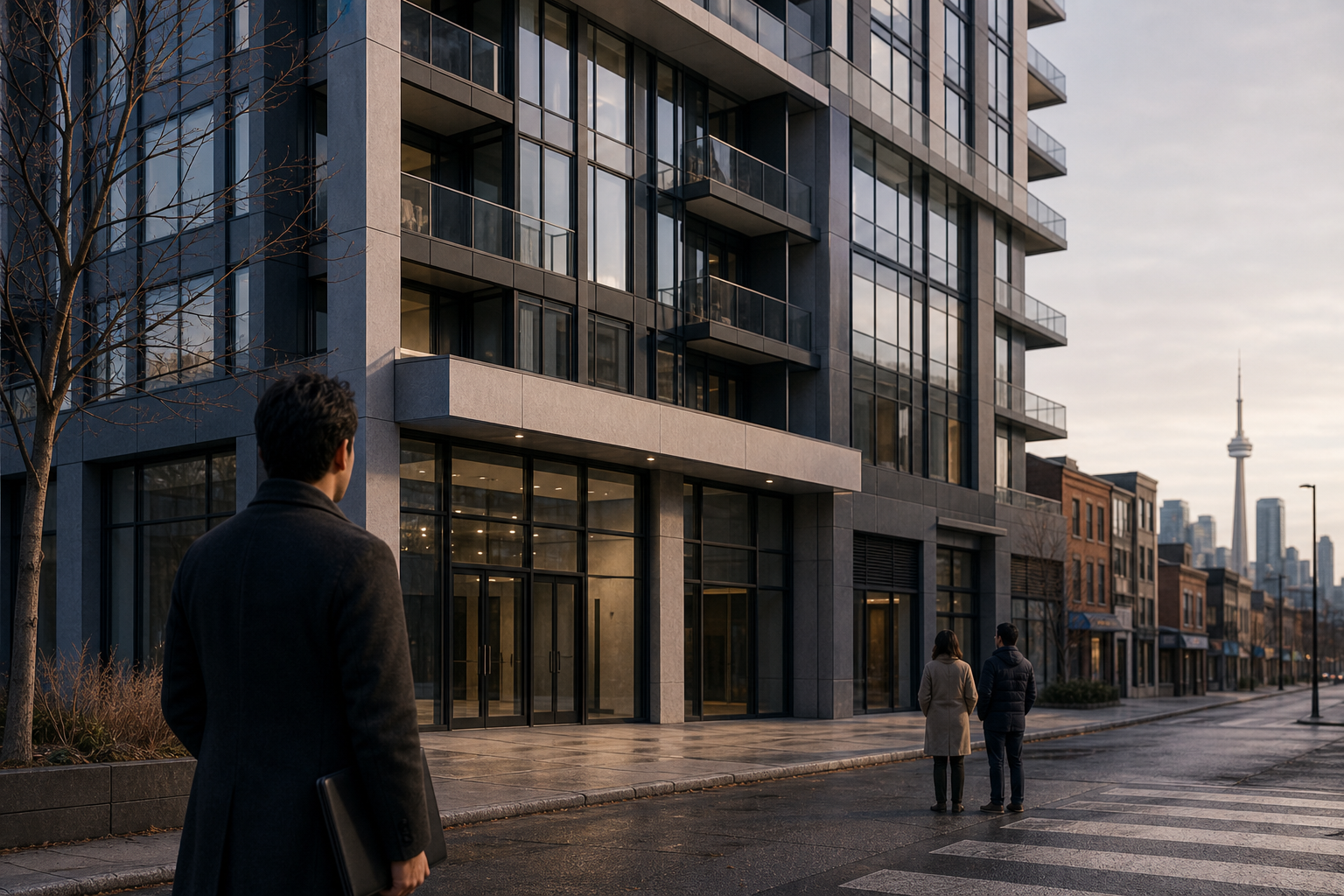

KSV Restructuring Inc. now controls an 11-storey building at 1478 Kingston Road that nobody can legally occupy. The Manderley stands finished, elevators installed, units painted, lobbies tiled, but its 121 residential units remain empty while the Ontario Superior Court works through the receivership filing triggered by defaulted senior debt exceeding $70 million. The building's physical completion makes the legal problem harder, not easier.
Most condo receiverships happen during excavation or framing, when the financial collapse is visible in the half-built structure. The Manderley represents a newer failure mode: the project that crosses the finish line but can't get anyone across the threshold. Substantial completion shifts the receiver's job from "finish construction" to "monetize inventory and untangle purchase agreements," which introduces a question that didn't exist a decade ago in Toronto's market. What happens to buyers who signed agreements of purchase and sale in 2018 or 2019, paid their deposits into trust, and are now watching a court-appointed accountant decide whether those contracts survive?
The equitable interest problem
Under Ontario law, purchasers of pre-construction condos hold what's called equitable interest, they don't own the unit, but they have a contractual right to own it once the deal closes. In receivership, the court can authorize the receiver to disclaim those agreements if doing so improves recovery for creditors. If current market prices for completed units in Birch Cliff exceed what original buyers agreed to pay, the receiver has an economic incentive to void the old contracts, refund the deposits through Tarion, and sell the units at 2025 prices.
This isn't theoretical. Buyers who locked in pre-construction pricing before rates rose now face the possibility of losing not just their anticipated home but the spread between what they agreed to pay and what the unit would cost today. Tarion protects the deposit, the money comes back, but it doesn't protect the deal. A purchaser who committed $680,000 in 2019 for a unit now worth $740,000 gets their $68,000 deposit returned and nothing else.
The irony is sharpest in Birch Cliff, where the City of Toronto has actively pushed mid-rise density along Kingston Road as part of its transit-oriented development strategy. The Manderley was supposed to anchor neighbourhood revitalization by adding 121 households within walking distance of the planned Ontario Line extension. Instead, it sits as a finished shell while the legal process works backward through the capital stack, delaying exactly the economic activity the zoning was meant to encourage.
Why substantial completion changes the math
When a project fails early, lenders and receivers can often agree on a path forward: bring in new equity, finish the building, close the units, pay down the debt. Substantial completion removes that option. The building is done. The only variables left are price and speed, and those variables now favour walking away from the original purchase agreements if the market has moved.
The result is a kind of phantom inventory, units that are built, registered, and ready for occupancy but legally frozen while the receiver maximizes sale proceeds for creditors. It's a physical success dressed up as a financial ghost ship. For the 121 purchasers, the wait isn't about construction delays. It's about whether the court will let them complete the purchase they thought they'd already made.
Toronto has seen a record number of condo completions through late 2024 and into 2025, even as pre-construction sales hit 20-year lows. The mismatch between supply and demand was supposed to resolve through price corrections, not receiverships of finished buildings. The Manderley suggests that assumption was wrong.
Read Next
Ottawa Can Win Against Cleveland-Cliffs and Still Lose on Steel Tariffs
143,929 Approved Homes Sit Unbuilt: What Is Really Holding Back Canada's Supply
Northeastern PA or the Big City: What the Same Budget Buys in Each
7 Co-Ownership Agreements That Protect Both the Friendship and the Equity