Independent writing on tax-smart planning, mortgage strategy, and retirement building. For Canadian professionals who want the whole picture, not just a piece of it.
Greater Sudbury, Timmins, Thunder Bay: Why Mining Investment Is Reshaping Northern Ontario Real Estate
Vale's announcement in late 2024 that it would pump $2.1 billion into its Sudbury operations, the largest single capital commitment in the company's Canadian history, marked the kind of shift that quietly reorganizes a regional economy. That investment, along with commitments from Glencore and new lithium projects near Thunder Bay, has moved roughly $6 billion into Northern Ontario's mining sector since mid-2024. The housing markets followed.
Greater Sudbury's benchmark single-family home price climbed 11% year-over-year through Q1 2026, outpacing Toronto's 3.2% over the same window. Timmins recorded an 8% gain. Thunder Bay, which had been functionally flat for the better part of a decade, posted 6%. These are not boom-cycle numbers. They are the kind of steady uptick that appears when demand is structural rather than speculative.
What mining capital does to housing demand
Mining investment at this scale doesn't just mean more jobs at the mine site. Vale's expansion in Sudbury includes a new processing facility that will operate through 2040, which translates to hiring timelines measured in years, not quarters. Glencore's Onaping Depth project, also near Sudbury, is adding another 200 underground positions through 2027. These are full-time roles with wages in the $80,000, $120,000 range, and they tend to pull in workers who plan to stay.
The housing response has been predictable in its direction but notable in its tightness. Greater Sudbury's active listings dropped to 340 units in March 2026, down from 520 a year earlier. Timmins had 89 active listings at the end of Q1, the lowest March inventory since the city started tracking the figure in 2003. Thunder Bay's supply has held steadier, partly because its job growth has been more distributed across forestry and port operations rather than concentrated in one sector, but even there inventory is down 18% year-over-year.
Why this cycle looks different from the last one
Northern Ontario has seen mining investment before. The nickel boom of the mid-2000s pushed Sudbury prices up sharply, then left them sideways for years when commodity prices dropped and projects wound down. What makes the current wave different is the composition of the capital. Roughly 40% of the new investment is aimed at battery metals, nickel, lithium, cobalt, tied to contracts with automotive manufacturers that extend into the 2030s. These are purchase agreements with fixed tonnage commitments, not spot-market plays. The revenue stream is more predictable, and the hiring timelines reflect that.
Thunder Bay's real estate market, historically the most stable of the three cities, is benefiting less from direct mine employment and more from its position as a logistics hub for the projects farther north. The port is handling increased shipments of equipment and processed materials, which has added warehouse and transportation jobs without the cyclicality of extraction work. That steadiness shows up in price behavior, Thunder Bay's gains have been smaller but less volatile.
The constraint that hasn't shifted
None of these markets had meaningful construction pipelines before the investment wave arrived. Sudbury issued permits for 87 single-family units in 2025, roughly in line with its ten-year average. Timmins issued 34. Thunder Bay's new-build activity has been marginally higher, but still well below what would be needed to absorb sustained in-migration. The price increases are a direct function of that gap. Builders in these cities face higher per-unit costs than their southern counterparts, longer material shipping times, smaller contractor pools, shorter construction seasons, and the financing for speculative builds has been harder to access even as demand has firmed.
The result is a market where prices are rising not because of speculation but because there are more people with stable incomes competing for a fixed stock of housing. That's a different problem than affordability crises driven by investor activity. It's also harder to solve quickly.


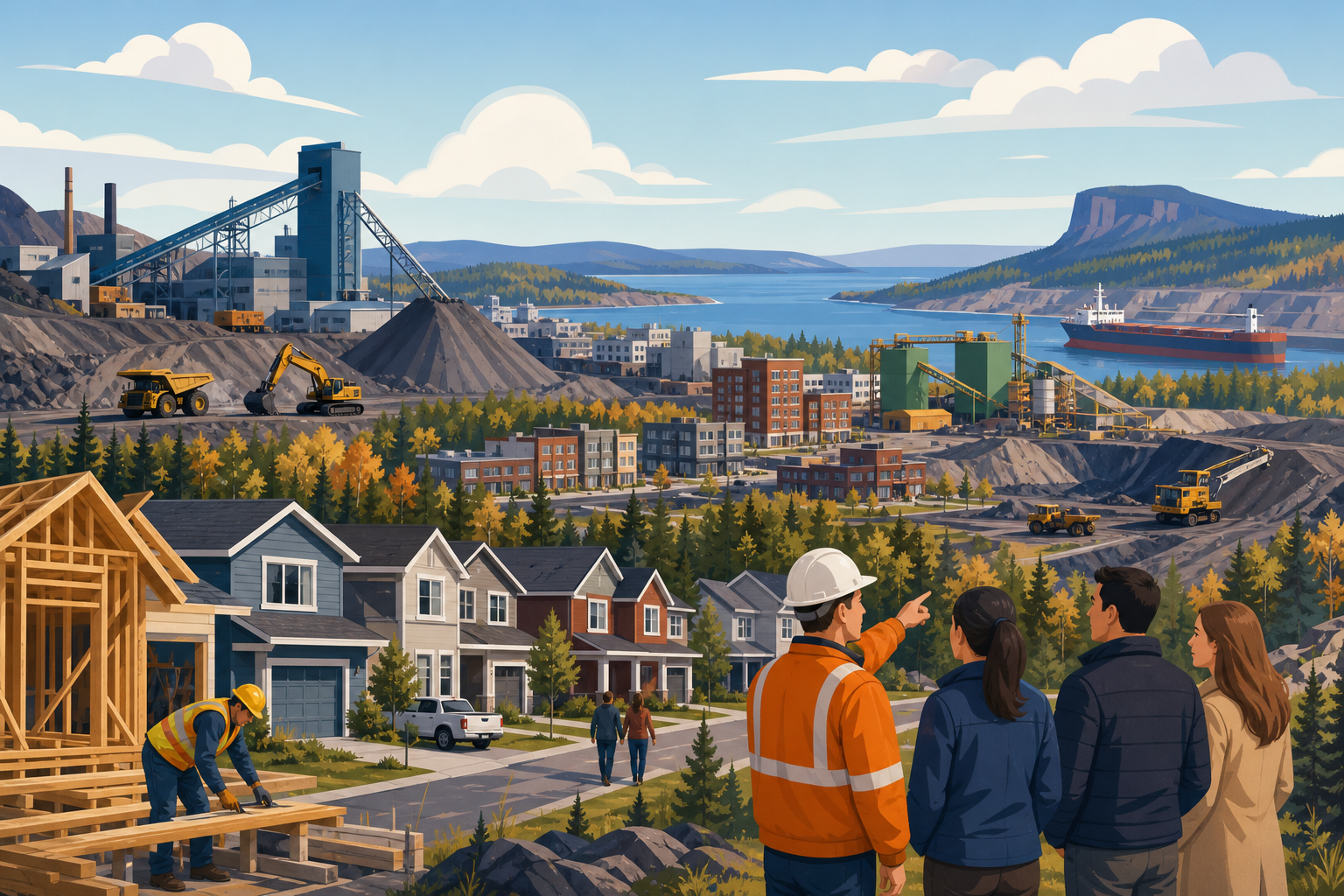

Vale's announcement in late 2024 that it would pump $2.1 billion into its Sudbury operations, the largest single capital commitment in the company's Canadian history, marked the kind of shift that quietly reorganizes a regional economy. That investment, along with commitments from Glencore and new lithium projects near Thunder Bay, has moved roughly $6 billion into Northern Ontario's mining sector since mid-2024. The housing markets followed.
Greater Sudbury's benchmark single-family home price climbed 11% year-over-year through Q1 2026, outpacing Toronto's 3.2% over the same window. Timmins recorded an 8% gain. Thunder Bay, which had been functionally flat for the better part of a decade, posted 6%. These are not boom-cycle numbers. They are the kind of steady uptick that appears when demand is structural rather than speculative.
What mining capital does to housing demand
Mining investment at this scale doesn't just mean more jobs at the mine site. Vale's expansion in Sudbury includes a new processing facility that will operate through 2040, which translates to hiring timelines measured in years, not quarters. Glencore's Onaping Depth project, also near Sudbury, is adding another 200 underground positions through 2027. These are full-time roles with wages in the $80,000, $120,000 range, and they tend to pull in workers who plan to stay.
The housing response has been predictable in its direction but notable in its tightness. Greater Sudbury's active listings dropped to 340 units in March 2026, down from 520 a year earlier. Timmins had 89 active listings at the end of Q1, the lowest March inventory since the city started tracking the figure in 2003. Thunder Bay's supply has held steadier, partly because its job growth has been more distributed across forestry and port operations rather than concentrated in one sector, but even there inventory is down 18% year-over-year.
Why this cycle looks different from the last one
Northern Ontario has seen mining investment before. The nickel boom of the mid-2000s pushed Sudbury prices up sharply, then left them sideways for years when commodity prices dropped and projects wound down. What makes the current wave different is the composition of the capital. Roughly 40% of the new investment is aimed at battery metals, nickel, lithium, cobalt, tied to contracts with automotive manufacturers that extend into the 2030s. These are purchase agreements with fixed tonnage commitments, not spot-market plays. The revenue stream is more predictable, and the hiring timelines reflect that.
Thunder Bay's real estate market, historically the most stable of the three cities, is benefiting less from direct mine employment and more from its position as a logistics hub for the projects farther north. The port is handling increased shipments of equipment and processed materials, which has added warehouse and transportation jobs without the cyclicality of extraction work. That steadiness shows up in price behavior, Thunder Bay's gains have been smaller but less volatile.
The constraint that hasn't shifted
None of these markets had meaningful construction pipelines before the investment wave arrived. Sudbury issued permits for 87 single-family units in 2025, roughly in line with its ten-year average. Timmins issued 34. Thunder Bay's new-build activity has been marginally higher, but still well below what would be needed to absorb sustained in-migration. The price increases are a direct function of that gap. Builders in these cities face higher per-unit costs than their southern counterparts, longer material shipping times, smaller contractor pools, shorter construction seasons, and the financing for speculative builds has been harder to access even as demand has firmed.
The result is a market where prices are rising not because of speculation but because there are more people with stable incomes competing for a fixed stock of housing. That's a different problem than affordability crises driven by investor activity. It's also harder to solve quickly.
Read Next
Ottawa Can Win Against Cleveland-Cliffs and Still Lose on Steel Tariffs
143,929 Approved Homes Sit Unbuilt: What Is Really Holding Back Canada's Supply
Northeastern PA or the Big City: What the Same Budget Buys in Each
7 Co-Ownership Agreements That Protect Both the Friendship and the Equity