Independent writing on tax-smart planning, mortgage strategy, and retirement building. For Canadian professionals who want the whole picture, not just a piece of it.
Canadians Pay 47% More for Homes Near Top Schools, And Halifax Can't Build Fast Enough
A three-bedroom semi in Toronto's Beach district sold last month for $1.3 million. The identical floor plan two blocks east, outside the catchment zone for a Fraser Institute top-ten elementary school, went for $890,000. The difference wasn't the house. It was the invisible fence.
Across Canada, proximity to high-ranking schools now commands a measurable premium that borders on ransom. Properties within walking distance of top-decile elementary schools trade at prices 10% to 20% above comparable homes just outside the boundary, and in high-pressure markets like Vancouver and Toronto, that spread widens to 30% or more. The calculus is brutal: parents with school-age children either pay the premium or resign themselves to a daily drive, a private school tuition bill, or a compromise school they didn't want.
The premium isn't new, but its scale has widened as school rankings became widely accessible and as remote work loosened the constraint of commuting to the office. For families shopping in 2026, school catchment is often the first filter applied, ahead of square footage or even neighborhood preference. Realtors report buyers rejecting otherwise suitable homes the moment they learn the property falls outside the desired zone. The street becomes the border, and the border is absolute.
What rankings actually measure
The irony is that school rankings, particularly those published by the Fraser Institute, correlate more strongly with the income and education level of parents in the catchment than with teaching quality. High-scoring schools sit in high-income neighborhoods where students arrive with tutors, stability, and parental involvement. The ranking becomes a proxy for class sorting, and the housing premium locks that sorting in place. A family willing to stretch financially to buy into the zone is signaling something the ranking already reflects: resources. The loop closes.
Critics of the ranking system argue this creates a feedback mechanism that entrenches inequality. Schools in lower-income areas receive lower rankings not because the teachers are worse but because the students face challenges that test scores don't control for. Parents fleeing those schools in favor of ranked alternatives accelerate the divergence. The premium isn't buying better education. It's buying access to a peer group.
Halifax's structural problem
If the school premium is a Canada-wide pattern, Halifax is where the supply constraint makes it particularly painful. The city has absorbed wave after wave of interprovincial migration, families leaving the GTA and Metro Vancouver in search of affordability, and construction has not kept pace. Inventory in desirable suburban corridors now sits below two months of supply, a threshold that historically triggers bidding wars. Homes that would have sold for $350,000 in 2019 are clearing $650,000 in early 2026, and the most sought-after school zones see premiums layered on top of that base inflation.
The shortage isn't just demand-driven. Zoning delays, a shortage of skilled trades, and rising material costs have throttled the pace of new builds. Developers report timelines stretching 18 to 24 months from approval to occupancy, and municipal infrastructure, water, transit, healthcare, hasn't caught up to the density. What was marketed as an affordable alternative to Toronto is now facing the early stages of the same housing trap: too many buyers, too few homes, and a planning system that moves slower than migration.
The rate gamble
Layered on top of the supply crunch is the mortgage rate question. Five-year fixed rates are currently settling in the 4.2% to 4.8% range, with the most competitive insured options dipping near 4.0%. Variable rates hover around Prime minus 0.50% to 1.00%, depending on the lender and the buyer's profile. The decision between fixed and variable has become a bet on the Bank of Canada's trajectory. Buyers who lock in a five-year fixed are paying for certainty. Buyers who go variable are betting that rates trend lower through 2026 and beyond.
The psychology is messy. Many buyers are waiting for rates to drop before entering the market, expecting that a return to sub-3% territory will restore affordability. The historical average suggests otherwise. Current rates are normal. The decade of sub-2% money was the anomaly, and waiting for its return may mean waiting indefinitely.


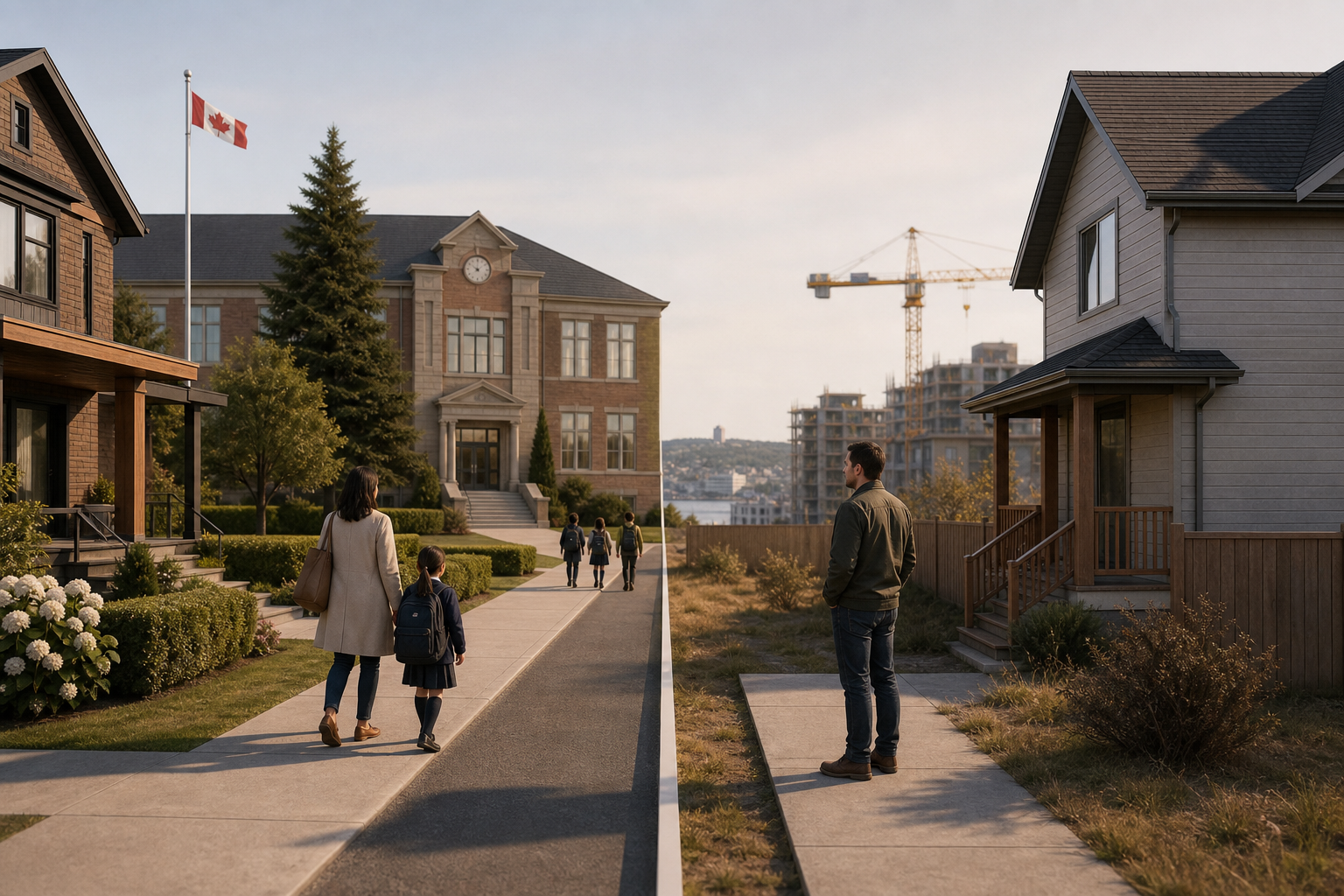

A three-bedroom semi in Toronto's Beach district sold last month for $1.3 million. The identical floor plan two blocks east, outside the catchment zone for a Fraser Institute top-ten elementary school, went for $890,000. The difference wasn't the house. It was the invisible fence.
Across Canada, proximity to high-ranking schools now commands a measurable premium that borders on ransom. Properties within walking distance of top-decile elementary schools trade at prices 10% to 20% above comparable homes just outside the boundary, and in high-pressure markets like Vancouver and Toronto, that spread widens to 30% or more. The calculus is brutal: parents with school-age children either pay the premium or resign themselves to a daily drive, a private school tuition bill, or a compromise school they didn't want.
The premium isn't new, but its scale has widened as school rankings became widely accessible and as remote work loosened the constraint of commuting to the office. For families shopping in 2026, school catchment is often the first filter applied, ahead of square footage or even neighborhood preference. Realtors report buyers rejecting otherwise suitable homes the moment they learn the property falls outside the desired zone. The street becomes the border, and the border is absolute.
What rankings actually measure
The irony is that school rankings, particularly those published by the Fraser Institute, correlate more strongly with the income and education level of parents in the catchment than with teaching quality. High-scoring schools sit in high-income neighborhoods where students arrive with tutors, stability, and parental involvement. The ranking becomes a proxy for class sorting, and the housing premium locks that sorting in place. A family willing to stretch financially to buy into the zone is signaling something the ranking already reflects: resources. The loop closes.
Critics of the ranking system argue this creates a feedback mechanism that entrenches inequality. Schools in lower-income areas receive lower rankings not because the teachers are worse but because the students face challenges that test scores don't control for. Parents fleeing those schools in favor of ranked alternatives accelerate the divergence. The premium isn't buying better education. It's buying access to a peer group.
Halifax's structural problem
If the school premium is a Canada-wide pattern, Halifax is where the supply constraint makes it particularly painful. The city has absorbed wave after wave of interprovincial migration, families leaving the GTA and Metro Vancouver in search of affordability, and construction has not kept pace. Inventory in desirable suburban corridors now sits below two months of supply, a threshold that historically triggers bidding wars. Homes that would have sold for $350,000 in 2019 are clearing $650,000 in early 2026, and the most sought-after school zones see premiums layered on top of that base inflation.
The shortage isn't just demand-driven. Zoning delays, a shortage of skilled trades, and rising material costs have throttled the pace of new builds. Developers report timelines stretching 18 to 24 months from approval to occupancy, and municipal infrastructure, water, transit, healthcare, hasn't caught up to the density. What was marketed as an affordable alternative to Toronto is now facing the early stages of the same housing trap: too many buyers, too few homes, and a planning system that moves slower than migration.
The rate gamble
Layered on top of the supply crunch is the mortgage rate question. Five-year fixed rates are currently settling in the 4.2% to 4.8% range, with the most competitive insured options dipping near 4.0%. Variable rates hover around Prime minus 0.50% to 1.00%, depending on the lender and the buyer's profile. The decision between fixed and variable has become a bet on the Bank of Canada's trajectory. Buyers who lock in a five-year fixed are paying for certainty. Buyers who go variable are betting that rates trend lower through 2026 and beyond.
The psychology is messy. Many buyers are waiting for rates to drop before entering the market, expecting that a return to sub-3% territory will restore affordability. The historical average suggests otherwise. Current rates are normal. The decade of sub-2% money was the anomaly, and waiting for its return may mean waiting indefinitely.
Read Next
Ottawa Can Win Against Cleveland-Cliffs and Still Lose on Steel Tariffs
143,929 Approved Homes Sit Unbuilt: What Is Really Holding Back Canada's Supply
Northeastern PA or the Big City: What the Same Budget Buys in Each
7 Co-Ownership Agreements That Protect Both the Friendship and the Equity