Independent writing on tax-smart planning, mortgage strategy, and retirement building. For Canadian professionals who want the whole picture, not just a piece of it.
Canada's Rental Pivot Looks Like a Housing Win Until You Map the Ownership Gap
In October 2025, a developer in Toronto's King West corridor quietly changed the marketing on a stalled 34-storey tower from "luxury condos" to "purpose-built rentals." The project was 41% pre-sold, nowhere near the 70% needed to secure construction financing. Within six weeks of the pivot, it had a commitment letter from a pension fund and a federal low-interest construction loan. The building will break ground this spring. None of the units will ever be for sale.
That story is repeating across the country. Canada's housing start numbers look robust, roughly 240,000 units are expected to begin construction in 2026, but the composition has flipped. Purpose-built rentals now represent the largest share of new starts in decades, while condo projects sit frozen at the pre-sale stage. The federal GST rebate on new rentals and the expansion of the Canada Mortgage Bond program to $60 billion have made it financially rational to build housing that nobody can own. The policy goal was to increase supply. The structural effect is to narrow the ownership funnel at exactly the moment when an entire generation is aging into homebuying years.
The pivot makes sense on paper. High interest rates killed the condo investor class, the people who used to buy units off-plan to rent them out. At a 5.5% mortgage rate, most new condos are cash-flow negative from day one. Pre-sales have stalled. Developers can't start construction without them. Rentals, by contrast, can be financed with institutional capital that doesn't require individual buyers to absorb the carrying cost. Projects that would have died as condos are moving forward as rentals, keeping the construction industry employed and adding units to a tight market.
The Wealth Machine Stops Running
Here's what that leaves out. For two generations, homeownership in Canada has been the primary mechanism for building household wealth. A 32-year-old buying a condo in 2006 for $280,000 in Toronto saw that asset appreciate to $650,000 by 2021, even as they paid down the mortgage. A 32-year-old renting that same unit contributed to someone else's equity and left the decade with a savings account, if they were disciplined, and nothing structural if they weren't.
The rental surge doesn't just shift tenure, it shifts who captures the appreciation. When the stock is owned by pension funds, REITs, and institutional landlords, the wealth accumulation from rising property values flows to those balance sheets, not to the household living in the unit. A supply increase that doesn't include an ownership component is a transfer, not a solution.
The Desjardins analysis, released in early 2026, flags this directly. Economist Kari Norman points out that while rental supply is necessary, the decline in ownership-focused starts creates a long-term inequality problem. Fewer people entering the ownership market means fewer people with an inflation-hedged asset on their household balance sheet. The gap compounds. Renters in their 30s today will hit retirement without the forced savings vehicle homeownership provided their parents.
The counterargument is that supply is supply, any new unit reduces competition for existing stock and eases pressure. True, but incomplete. The rental towers going up in 2026 are marketed as "luxury" and priced accordingly. A one-bedroom in a new purpose-built building in Vancouver rents for $2,400. That's not affordable housing. It's market-rate product for high earners who can't or won't buy. It does nothing for the lower-income renters being pushed out by rent inflation on older stock.
What the Pipeline Actually Built
By mid-2026, the pipeline is clear. Developers have pivoted mid-cycle, converting stalled condo projects into rentals to access government-backed financing. The housing start figures look healthy. But what's being built is a rentership infrastructure, not an ownership pathway. The 25-year-old starting their first job in 2026 is entering a market where the for-sale inventory is shrinking and the rental stock is controlled by institutions with no interest in selling.
The policy worked. Supply is increasing. The question nobody answered was: supply for whom, and who owns it when it's done?


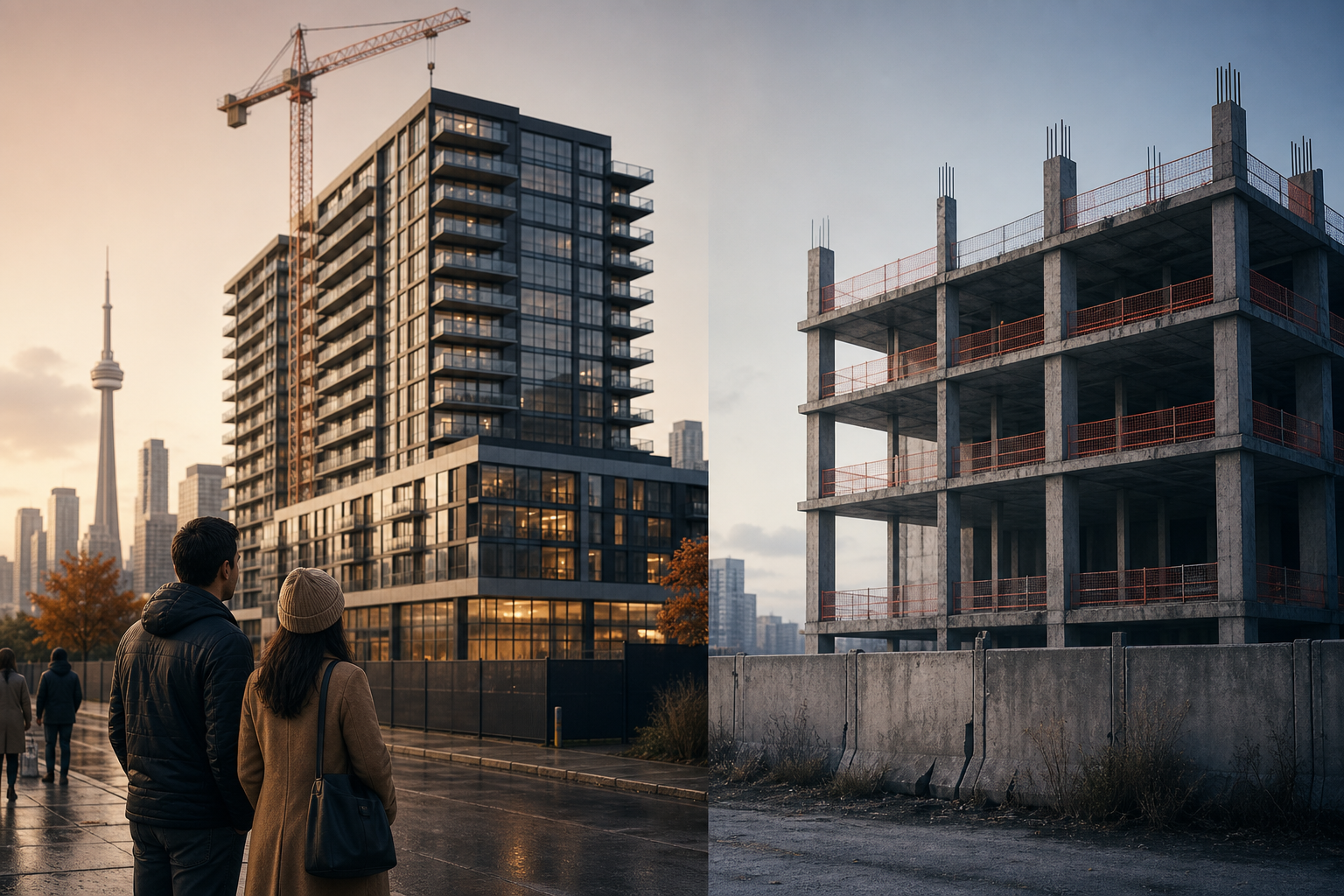

In October 2025, a developer in Toronto's King West corridor quietly changed the marketing on a stalled 34-storey tower from "luxury condos" to "purpose-built rentals." The project was 41% pre-sold, nowhere near the 70% needed to secure construction financing. Within six weeks of the pivot, it had a commitment letter from a pension fund and a federal low-interest construction loan. The building will break ground this spring. None of the units will ever be for sale.
That story is repeating across the country. Canada's housing start numbers look robust, roughly 240,000 units are expected to begin construction in 2026, but the composition has flipped. Purpose-built rentals now represent the largest share of new starts in decades, while condo projects sit frozen at the pre-sale stage. The federal GST rebate on new rentals and the expansion of the Canada Mortgage Bond program to $60 billion have made it financially rational to build housing that nobody can own. The policy goal was to increase supply. The structural effect is to narrow the ownership funnel at exactly the moment when an entire generation is aging into homebuying years.
The pivot makes sense on paper. High interest rates killed the condo investor class, the people who used to buy units off-plan to rent them out. At a 5.5% mortgage rate, most new condos are cash-flow negative from day one. Pre-sales have stalled. Developers can't start construction without them. Rentals, by contrast, can be financed with institutional capital that doesn't require individual buyers to absorb the carrying cost. Projects that would have died as condos are moving forward as rentals, keeping the construction industry employed and adding units to a tight market.
The Wealth Machine Stops Running
Here's what that leaves out. For two generations, homeownership in Canada has been the primary mechanism for building household wealth. A 32-year-old buying a condo in 2006 for $280,000 in Toronto saw that asset appreciate to $650,000 by 2021, even as they paid down the mortgage. A 32-year-old renting that same unit contributed to someone else's equity and left the decade with a savings account, if they were disciplined, and nothing structural if they weren't.
The rental surge doesn't just shift tenure, it shifts who captures the appreciation. When the stock is owned by pension funds, REITs, and institutional landlords, the wealth accumulation from rising property values flows to those balance sheets, not to the household living in the unit. A supply increase that doesn't include an ownership component is a transfer, not a solution.
The Desjardins analysis, released in early 2026, flags this directly. Economist Kari Norman points out that while rental supply is necessary, the decline in ownership-focused starts creates a long-term inequality problem. Fewer people entering the ownership market means fewer people with an inflation-hedged asset on their household balance sheet. The gap compounds. Renters in their 30s today will hit retirement without the forced savings vehicle homeownership provided their parents.
The counterargument is that supply is supply, any new unit reduces competition for existing stock and eases pressure. True, but incomplete. The rental towers going up in 2026 are marketed as "luxury" and priced accordingly. A one-bedroom in a new purpose-built building in Vancouver rents for $2,400. That's not affordable housing. It's market-rate product for high earners who can't or won't buy. It does nothing for the lower-income renters being pushed out by rent inflation on older stock.
What the Pipeline Actually Built
By mid-2026, the pipeline is clear. Developers have pivoted mid-cycle, converting stalled condo projects into rentals to access government-backed financing. The housing start figures look healthy. But what's being built is a rentership infrastructure, not an ownership pathway. The 25-year-old starting their first job in 2026 is entering a market where the for-sale inventory is shrinking and the rental stock is controlled by institutions with no interest in selling.
The policy worked. Supply is increasing. The question nobody answered was: supply for whom, and who owns it when it's done?
Read Next
7 Co-Ownership Agreements That Protect Both the Friendship and the Equity
The 2027 Housing Recovery in Canada Runs Through Business Investment
A Small Cut to 0.9% Growth Points to Canada's Longer Problem
Ottawa Already Holds the Income Data That Could Curb Mortgage Fraud