Independent writing on tax-smart planning, mortgage strategy, and retirement building. For Canadian professionals who want the whole picture, not just a piece of it.
Toronto's Penthouse Market Defies the Condo Slowdown: Sales Data Shows a Luxury Island
A 47-year-old tech executive in Yorkville recently closed on a 3,200-square-foot penthouse for $12.4 million. The transaction took 14 days from listing to firm offer. Three kilometres south, a two-bedroom condo priced at $780,000 has been sitting on the market for six weeks with two price reductions and no offers. Both are in downtown Toronto. Both are condominiums. The difference is everything.
Toronto's residential real estate market is experiencing a full structural decoupling. Sales of homes priced above $10 million surged roughly 200% year-over-year between 2025 and 2026, according to data from the Toronto Regional Real Estate Board. Meanwhile, entry-level condo inventory has climbed 25% over the same period, with average days on market stretching past 40 for units under $800,000. The gap is not cyclical. It is a separation of two markets that now operate under entirely different economic rules.
The Cash Buyer Advantage
The core driver is interest rate insulation. The sub-$1 million condo segment is dominated by buyers relying on mortgages, and carrying costs at current rates have effectively priced out marginal buyers and traditional investors. The $10 million-plus segment, by contrast, transacts overwhelmingly in cash. When the Bank of Canada raised rates, it moved the bottom half of the market into stasis. The top kept moving because debt was never part of the equation.
Toronto's ultra-luxury penthouses are now averaging under 20 days on market if priced correctly, half the time of a standard condo. Prime Yorkville units are clearing $3,500 per square foot, a threshold that would have been considered speculative even two years ago. The velocity is being driven not by speculation but by scarcity. There are only a finite number of true top-floor units with unobstructed lake or skyline views in the city. Unlike the commoditized one-bedroom market, these properties have no functional substitutes.
What Wealth Is Actually Buying
The $10 million buyer in 2026 is not buying square footage. The traditional estate in The Bridle Path, 10,000 square feet, sprawling grounds, high maintenance, is being passed over in favour of what the industry now calls "vertical estates." These are 3,000 to 5,000 square feet of turnkey living inside branded buildings: Four Seasons, Shangri-La, Nobu. The value proposition is not the unit. It is the serviced ecosystem around it.
Concierge teams that coordinate private chefs. Valet parking integrated with building security. In-suite catering from Michelin-calibre hotel kitchens. Wellness suites, private elevators, and zero exterior maintenance. The wealthy are not downsizing. They are outsourcing the friction of ownership. A penthouse buyer who previously would have employed a household staff is now paying a premium to let the building handle that operational layer.
This is the "hotelification" of housing at the top end. The asset being purchased is low-hassle, high-service real estate in a market where time has become more expensive than money.
The End of the Fixer-Upper Luxury
One of the sharper behavioral shifts: the death of the renovation-required luxury unit. Properties that need 18 months of designer work are sitting. Units that are move-in ready are seeing competitive bidding. The $10 million buyer in Toronto now displays what brokers describe as high "hassle-avoidance." They will pay a significant premium to eliminate project risk and timeline uncertainty.
Foreign buyer restrictions, extended through 2026, were expected to cool this market. They have not. The buyer base has shifted almost entirely to domestic capital: intergenerational wealth transfers, tech-sector exits, and financial services executives consolidating into the core. The concentration of capital in Toronto's upper tier has proven structurally durable, even as the national economy has cooled.
The condo market is not recovering in tandem. It is bifurcating permanently. One half is mortgage-sensitive, inventory-heavy, and waiting for rate relief. The other half is cash-driven, supply-constrained, and treating real estate as a low-volatility store of value with a view. The 200% jump in ultra-luxury sales is not an anomaly. It is the market repricing two different assets that used to share a category.


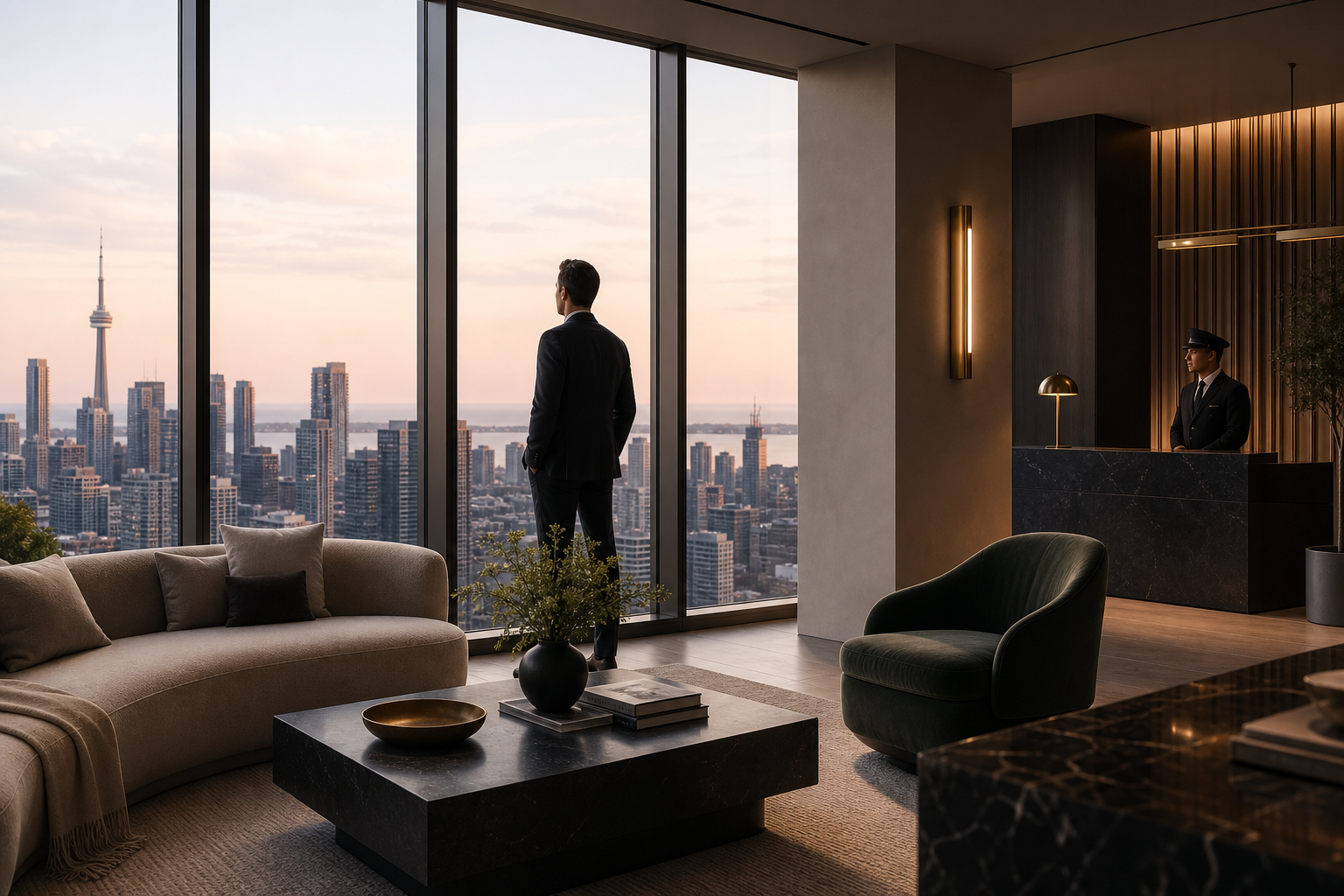

A 47-year-old tech executive in Yorkville recently closed on a 3,200-square-foot penthouse for $12.4 million. The transaction took 14 days from listing to firm offer. Three kilometres south, a two-bedroom condo priced at $780,000 has been sitting on the market for six weeks with two price reductions and no offers. Both are in downtown Toronto. Both are condominiums. The difference is everything.
Toronto's residential real estate market is experiencing a full structural decoupling. Sales of homes priced above $10 million surged roughly 200% year-over-year between 2025 and 2026, according to data from the Toronto Regional Real Estate Board. Meanwhile, entry-level condo inventory has climbed 25% over the same period, with average days on market stretching past 40 for units under $800,000. The gap is not cyclical. It is a separation of two markets that now operate under entirely different economic rules.
The Cash Buyer Advantage
The core driver is interest rate insulation. The sub-$1 million condo segment is dominated by buyers relying on mortgages, and carrying costs at current rates have effectively priced out marginal buyers and traditional investors. The $10 million-plus segment, by contrast, transacts overwhelmingly in cash. When the Bank of Canada raised rates, it moved the bottom half of the market into stasis. The top kept moving because debt was never part of the equation.
Toronto's ultra-luxury penthouses are now averaging under 20 days on market if priced correctly, half the time of a standard condo. Prime Yorkville units are clearing $3,500 per square foot, a threshold that would have been considered speculative even two years ago. The velocity is being driven not by speculation but by scarcity. There are only a finite number of true top-floor units with unobstructed lake or skyline views in the city. Unlike the commoditized one-bedroom market, these properties have no functional substitutes.
What Wealth Is Actually Buying
The $10 million buyer in 2026 is not buying square footage. The traditional estate in The Bridle Path, 10,000 square feet, sprawling grounds, high maintenance, is being passed over in favour of what the industry now calls "vertical estates." These are 3,000 to 5,000 square feet of turnkey living inside branded buildings: Four Seasons, Shangri-La, Nobu. The value proposition is not the unit. It is the serviced ecosystem around it.
Concierge teams that coordinate private chefs. Valet parking integrated with building security. In-suite catering from Michelin-calibre hotel kitchens. Wellness suites, private elevators, and zero exterior maintenance. The wealthy are not downsizing. They are outsourcing the friction of ownership. A penthouse buyer who previously would have employed a household staff is now paying a premium to let the building handle that operational layer.
This is the "hotelification" of housing at the top end. The asset being purchased is low-hassle, high-service real estate in a market where time has become more expensive than money.
The End of the Fixer-Upper Luxury
One of the sharper behavioral shifts: the death of the renovation-required luxury unit. Properties that need 18 months of designer work are sitting. Units that are move-in ready are seeing competitive bidding. The $10 million buyer in Toronto now displays what brokers describe as high "hassle-avoidance." They will pay a significant premium to eliminate project risk and timeline uncertainty.
Foreign buyer restrictions, extended through 2026, were expected to cool this market. They have not. The buyer base has shifted almost entirely to domestic capital: intergenerational wealth transfers, tech-sector exits, and financial services executives consolidating into the core. The concentration of capital in Toronto's upper tier has proven structurally durable, even as the national economy has cooled.
The condo market is not recovering in tandem. It is bifurcating permanently. One half is mortgage-sensitive, inventory-heavy, and waiting for rate relief. The other half is cash-driven, supply-constrained, and treating real estate as a low-volatility store of value with a view. The 200% jump in ultra-luxury sales is not an anomaly. It is the market repricing two different assets that used to share a category.
Read Next
Ottawa Can Win Against Cleveland-Cliffs and Still Lose on Steel Tariffs
143,929 Approved Homes Sit Unbuilt: What Is Really Holding Back Canada's Supply
Northeastern PA or the Big City: What the Same Budget Buys in Each
7 Co-Ownership Agreements That Protect Both the Friendship and the Equity