Independent writing on tax-smart planning, mortgage strategy, and retirement building. For Canadian professionals who want the whole picture, not just a piece of it.
Trump's Michigan Visit Exposes the Gordie Howe Bridge Problem Canada Can't Ignore
The $4.5-billion Gordie Howe International Bridge opened for traffic in late 2025 with full ceremony and fanfare. Within six months, the volume of goods crossing it had dropped 18 percent below projected levels. The problem wasn't the bridge. It was the cost of using it.
Donald Trump's recent visit to Michigan wasn't about infrastructure. It was about tariffs, and specifically about the 10-to-20 percent universal baseline levy his administration has floated on nearly all imported goods. For Michigan, that policy carries unusual weight. The state's automotive supply chain doesn't stop at the border, it crosses it multiple times. A single vehicle component might move between Windsor and Detroit three or four times before final assembly. Each crossing now risks becoming a taxable event.
Why the compounding effect matters
The standard framing treats tariffs as a one-time cost at point of entry. That framing breaks down when production is genuinely integrated. A stamped steel part crosses from Ontario to Michigan for welding, returns to Windsor for coating, crosses again for sub-assembly, and finally re-enters the U.S. as part of a finished module. If each crossing triggers even a partial tariff, the effective tax rate compounds. A 10 percent levy applied four times doesn't produce a 10 percent cost increase. It produces something closer to 46 percent, depending on how value-added is calculated at each stage.
Canadian officials have begun using the term "economic auto-immune disease" in private briefings. The metaphor holds. The Ontario-Michigan automotive corridor functions as a single organism. Taxing flows within it penalizes the system's own circulation.
Trump's argument in Michigan was straightforward: high tariffs force reshoring, and reshoring protects Michigan jobs from Chinese competition. The logic has traction with voters. What it doesn't account for is the difference between reshoring from Asia and disrupting flows from Ontario. The former changes where components come from. The latter raises the cost of making anything at all.
The 2026 pressure point
The Gordie Howe Bridge was designed to handle 8,000 trucks daily by 2028, reducing congestion at the aging Ambassador Bridge and cutting cross-border transit times by roughly 30 percent. That math assumed stable or growing trade volumes. It did not assume a policy environment where each crossing incurs a new cost layer.
The real test comes in 2026, when the USMCA undergoes its mandatory six-year review. Any party can signal intent to withdraw. Trump has used that leverage point before, his first-term renegotiation of NAFTA hinged on the credible threat of walking away entirely. The current tariff rhetoric functions as a soft opening for that negotiation. Canada's retaliatory tariffs, historically applied dollar-for-dollar on politically sensitive U.S. goods, are the expected counter-move. The result is a spiral where neither side's manufacturing base benefits.
What the bridge reveals
Infrastructure investment assumes continuity. You don't spend $4.5 billion to speed up trade flows if you plan to throttle the volume of trade crossing the bridge. The contradiction exposes the gap between what gets built and what gets permitted to move.
Roughly 2.5 million Canadian jobs depend directly on trade with the United States. Michigan employs over 160,000 workers in automotive manufacturing alone, many of them reliant


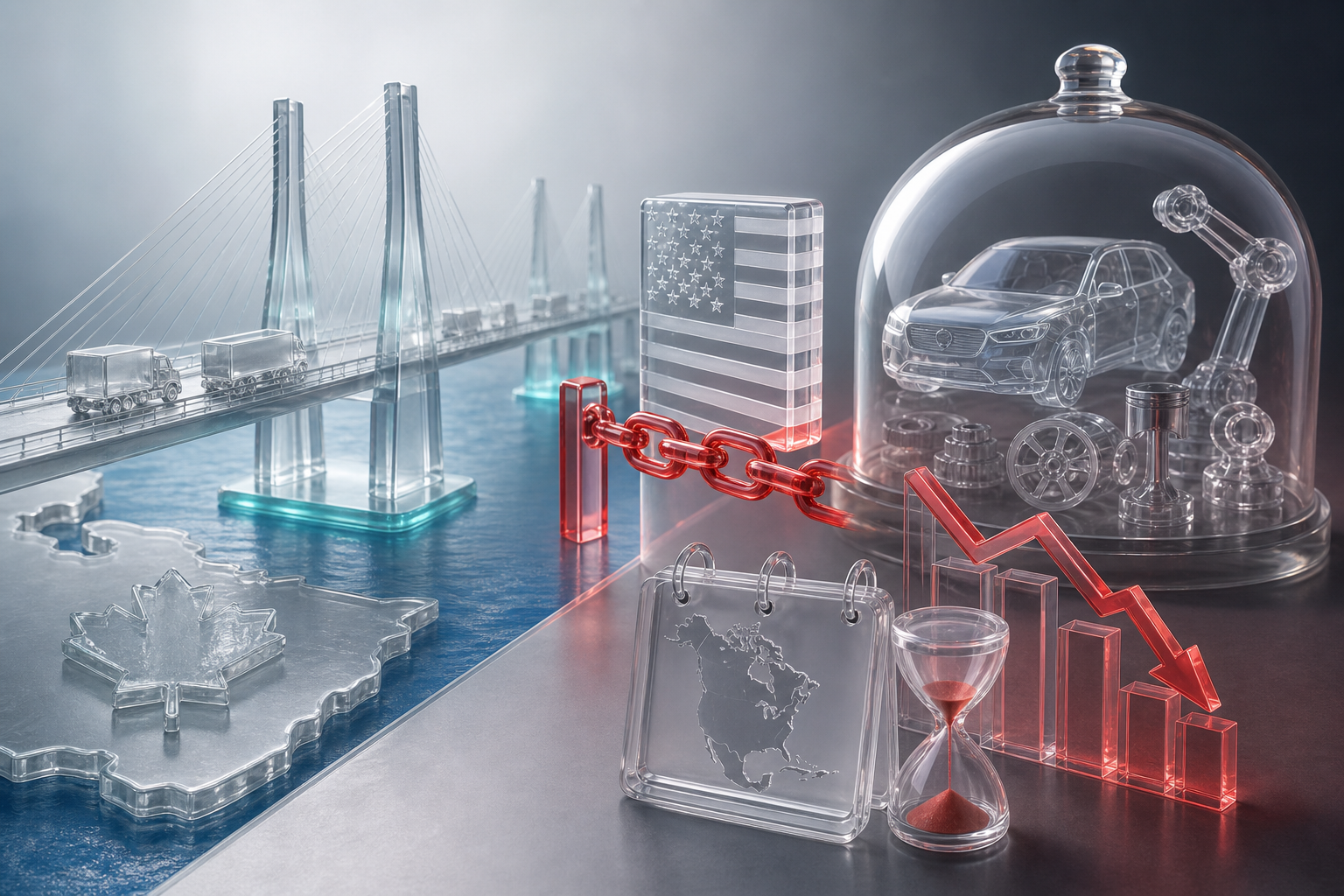

The $4.5-billion Gordie Howe International Bridge opened for traffic in late 2025 with full ceremony and fanfare. Within six months, the volume of goods crossing it had dropped 18 percent below projected levels. The problem wasn't the bridge. It was the cost of using it.
Donald Trump's recent visit to Michigan wasn't about infrastructure. It was about tariffs, and specifically about the 10-to-20 percent universal baseline levy his administration has floated on nearly all imported goods. For Michigan, that policy carries unusual weight. The state's automotive supply chain doesn't stop at the border, it crosses it multiple times. A single vehicle component might move between Windsor and Detroit three or four times before final assembly. Each crossing now risks becoming a taxable event.
Why the compounding effect matters
The standard framing treats tariffs as a one-time cost at point of entry. That framing breaks down when production is genuinely integrated. A stamped steel part crosses from Ontario to Michigan for welding, returns to Windsor for coating, crosses again for sub-assembly, and finally re-enters the U.S. as part of a finished module. If each crossing triggers even a partial tariff, the effective tax rate compounds. A 10 percent levy applied four times doesn't produce a 10 percent cost increase. It produces something closer to 46 percent, depending on how value-added is calculated at each stage.
Canadian officials have begun using the term "economic auto-immune disease" in private briefings. The metaphor holds. The Ontario-Michigan automotive corridor functions as a single organism. Taxing flows within it penalizes the system's own circulation.
Trump's argument in Michigan was straightforward: high tariffs force reshoring, and reshoring protects Michigan jobs from Chinese competition. The logic has traction with voters. What it doesn't account for is the difference between reshoring from Asia and disrupting flows from Ontario. The former changes where components come from. The latter raises the cost of making anything at all.
The 2026 pressure point
The Gordie Howe Bridge was designed to handle 8,000 trucks daily by 2028, reducing congestion at the aging Ambassador Bridge and cutting cross-border transit times by roughly 30 percent. That math assumed stable or growing trade volumes. It did not assume a policy environment where each crossing incurs a new cost layer.
The real test comes in 2026, when the USMCA undergoes its mandatory six-year review. Any party can signal intent to withdraw. Trump has used that leverage point before, his first-term renegotiation of NAFTA hinged on the credible threat of walking away entirely. The current tariff rhetoric functions as a soft opening for that negotiation. Canada's retaliatory tariffs, historically applied dollar-for-dollar on politically sensitive U.S. goods, are the expected counter-move. The result is a spiral where neither side's manufacturing base benefits.
What the bridge reveals
Infrastructure investment assumes continuity. You don't spend $4.5 billion to speed up trade flows if you plan to throttle the volume of trade crossing the bridge. The contradiction exposes the gap between what gets built and what gets permitted to move.
Roughly 2.5 million Canadian jobs depend directly on trade with the United States. Michigan employs over 160,000 workers in automotive manufacturing alone, many of them reliant
Read Next
Ottawa Can Win Against Cleveland-Cliffs and Still Lose on Steel Tariffs
143,929 Approved Homes Sit Unbuilt: What Is Really Holding Back Canada's Supply
Northeastern PA or the Big City: What the Same Budget Buys in Each
7 Co-Ownership Agreements That Protect Both the Friendship and the Equity