Independent writing on tax-smart planning, mortgage strategy, and retirement building. For Canadian professionals who want the whole picture, not just a piece of it.
A paramedic dies responding to a call and an entire island stops to ask why
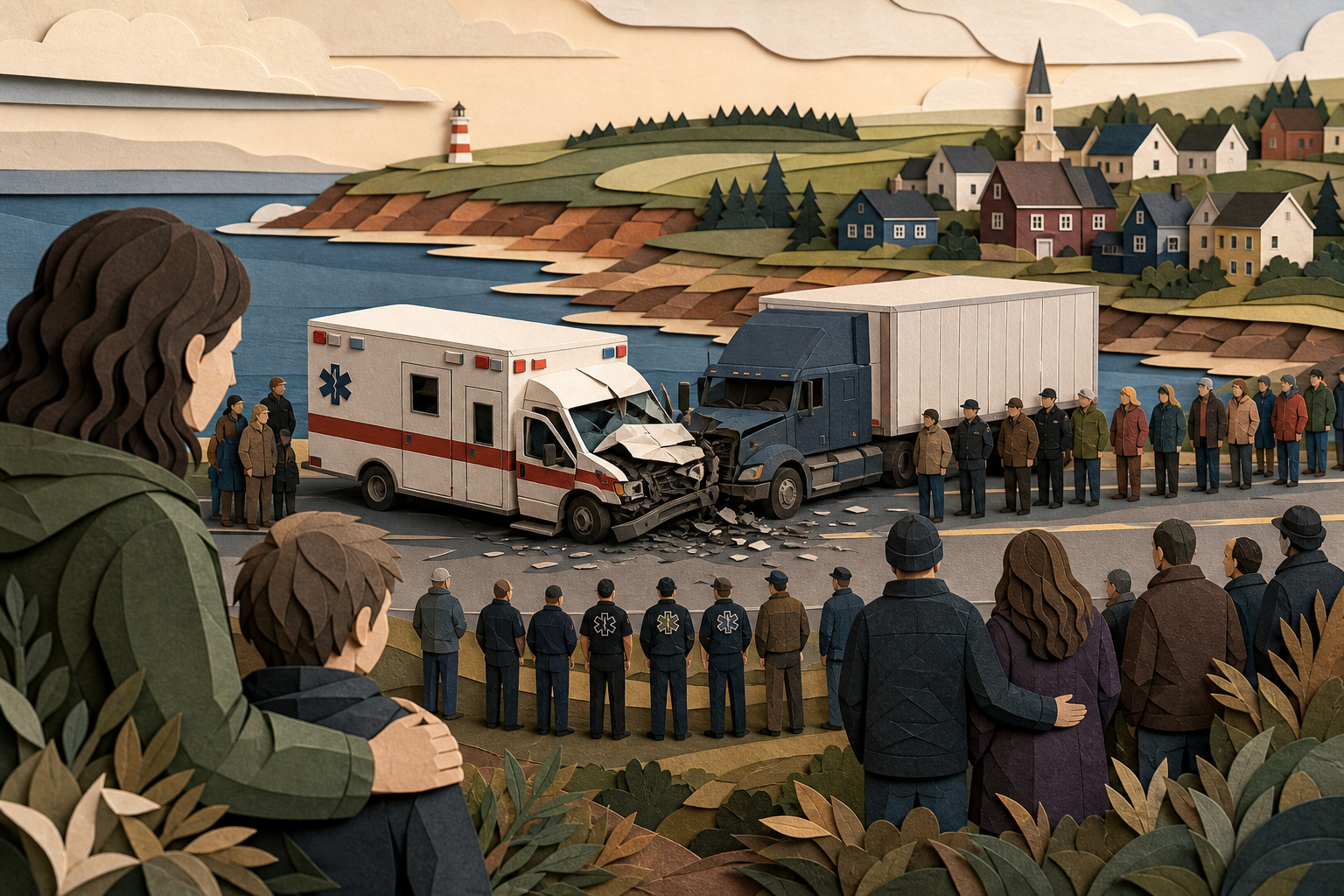
A 56-year-old paramedic named in Tuesday's collision between an ambulance and a transport truck in New Brunswick had spent decades responding to calls across Prince Edward Island. His colleagues knew him as the one who stayed late, who mentored new hires, who showed up to community events in uniform because he believed the job extended past the shift clock. Islands are small enough that most people either knew him or knew someone who did.
The crash happened on a clear day. No weather event, no visibility problem, just the routine geometry of an ambulance crossing paths with a commercial truck. Those are the details that make this harder, not easier. When there's no catastrophic external factor to point to, you're left looking at the thing itself: a vehicle carrying someone to help, destroyed by the infrastructure meant to move goods efficiently.
What gets normalized when you work rural EMS
P.E.I. has a population of roughly 175,000 spread across 5,600 square kilometers. That works out to transport times that would shock urban providers. A cardiac event in Tignish means a 90-minute drive to the Queen Elizabeth Hospital in Charlottetown if you're lucky with traffic. The roads are two-lane highways shared with agriculture equipment, tourist traffic in summer, and year-round commercial freight moving between the mainland and the island's distribution centers.
Paramedics here spend more time behind the wheel than on scene. That's not an exaggeration. A 12-hour shift can involve three hours of direct patient care and six hours of driving. The rest is restocking, handoffs, and documentation. The vehicle becomes your workspace, and the road becomes the variable you can't control but have to trust.
Tuesday's collision was the thing every first responder knows is possible and chooses not to dwell on because dwelling on it makes the job impossible. But it happened, and now the entire first-responder network on the island is asking what should have been different.
The systemic part no one wants to name
P.E.I. has been短 of paramedics for years. Island EMS, the province's primary service provider, has reported chronic understaffing since at least 2019. When you're short-staffed, the math is simple: the people who show up work more, drive more, cover more territory. Fatigue stops being an exception and becomes the baseline.
There is no public data on how many hours the paramedic killed Tuesday had worked in the week leading up to the crash. That information, if it exists, is locked inside an internal file and a pending investigation. But his colleagues are talking, and what they're saying is that this was someone who rarely turned down a shift.
When someone dies doing a job the public depends on, the first instinct is to call them a hero. It's easier than asking whether the system that relied on them was designed to keep them alive. Prince Edward Island is now doing both. The funeral will be attended by hundreds. The union will call for a staffing review. One of those things provides closure. The other requires money, political will, and an admission that the cost of keeping ambulances on the road has been pushed onto the people driving them for longer than anyone wants to count.



A 56-year-old paramedic named in Tuesday's collision between an ambulance and a transport truck in New Brunswick had spent decades responding to calls across Prince Edward Island. His colleagues knew him as the one who stayed late, who mentored new hires, who showed up to community events in uniform because he believed the job extended past the shift clock. Islands are small enough that most people either knew him or knew someone who did.
The crash happened on a clear day. No weather event, no visibility problem, just the routine geometry of an ambulance crossing paths with a commercial truck. Those are the details that make this harder, not easier. When there's no catastrophic external factor to point to, you're left looking at the thing itself: a vehicle carrying someone to help, destroyed by the infrastructure meant to move goods efficiently.
What gets normalized when you work rural EMS
P.E.I. has a population of roughly 175,000 spread across 5,600 square kilometers. That works out to transport times that would shock urban providers. A cardiac event in Tignish means a 90-minute drive to the Queen Elizabeth Hospital in Charlottetown if you're lucky with traffic. The roads are two-lane highways shared with agriculture equipment, tourist traffic in summer, and year-round commercial freight moving between the mainland and the island's distribution centers.
Paramedics here spend more time behind the wheel than on scene. That's not an exaggeration. A 12-hour shift can involve three hours of direct patient care and six hours of driving. The rest is restocking, handoffs, and documentation. The vehicle becomes your workspace, and the road becomes the variable you can't control but have to trust.
Tuesday's collision was the thing every first responder knows is possible and chooses not to dwell on because dwelling on it makes the job impossible. But it happened, and now the entire first-responder network on the island is asking what should have been different.
The systemic part no one wants to name
P.E.I. has been短 of paramedics for years. Island EMS, the province's primary service provider, has reported chronic understaffing since at least 2019. When you're short-staffed, the math is simple: the people who show up work more, drive more, cover more territory. Fatigue stops being an exception and becomes the baseline.
There is no public data on how many hours the paramedic killed Tuesday had worked in the week leading up to the crash. That information, if it exists, is locked inside an internal file and a pending investigation. But his colleagues are talking, and what they're saying is that this was someone who rarely turned down a shift.
When someone dies doing a job the public depends on, the first instinct is to call them a hero. It's easier than asking whether the system that relied on them was designed to keep them alive. Prince Edward Island is now doing both. The funeral will be attended by hundreds. The union will call for a staffing review. One of those things provides closure. The other requires money, political will, and an admission that the cost of keeping ambulances on the road has been pushed onto the people driving them for longer than anyone wants to count.
Read Next
Ottawa Can Win Against Cleveland-Cliffs and Still Lose on Steel Tariffs
143,929 Approved Homes Sit Unbuilt: What Is Really Holding Back Canada's Supply
Northeastern PA or the Big City: What the Same Budget Buys in Each
7 Co-Ownership Agreements That Protect Both the Friendship and the Equity