Independent writing on tax-smart planning, mortgage strategy, and retirement building. For Canadian professionals who want the whole picture, not just a piece of it.
The U.S. Alcohol Industry's Canada Problem Isn't Going Away After Tariffs End
In October 2024, a craft distiller in Louisville watched his Canadian distributor drop two of his bourbon labels from provincial liquor boards. The tariffs hadn't even taken effect yet. The distributor just wanted shelf space for products with a clearer price trajectory.
That's the actual Canada problem for U.S. alcohol producers: not the tariffs themselves, but the structural displacement they set in motion before the first duty gets collected. Canada buys roughly $452 million worth of American spirits annually, making it the largest export market for bourbon and Tennessee whiskey. When those products become 25% more expensive at retail, the gap doesn't stay empty. It fills with Scotch, Canadian whisky, or Japanese imports that don't carry the same political baggage.
Why shelf space doesn't come back
Provincial liquor monopolies in Canada operate on allocation models. A distillery that loses its spot on the LCBO's "core listing" doesn't automatically get it back when trade conditions normalize. The buyer has already moved inventory, reset the planogram, and signed contracts with replacement suppliers. Reclaiming that allocation means displacing someone else, which requires either a price concession or proof of sustained consumer demand that survived the tariff period.
American whiskey producers went through this exact sequence during the 2018 steel and aluminum dispute. When the EU imposed retaliatory tariffs on bourbon, U.S. exports to Europe dropped 13% in the first year. Some of that volume returned after the dispute ended in 2021, but the revenue never fully recovered. Brands that had been growing 8-10% annually in Germany and France were suddenly fighting to hold flat three years later.
The difference with Canada is proximity. European buyers treat American whiskey as a luxury import. Canadian buyers, especially in border provinces, treat it as a category anchor. Bars in Toronto and Vancouver stock bourbon the way bars in Chicago stock tequila: not as a premium pour, but as a everyday option at multiple price points. Losing that baseline presence means losing the structural access that makes Canadian distribution worth the logistics cost in the first place.
The craft distilling ceiling
Large producers like Brown-Forman and Diageo can absorb tariff-driven margin compression for several quarters. They have diversified portfolios, global distribution networks, and balance sheets that let them wait out trade disputes. A craft operation in Kentucky or Tennessee that does $4 million in annual revenue and sends 18% of its output to Canada cannot.
The arithmetic is straightforward. A 25% tariff on a product with a 22% gross margin after production costs and U.S. distribution doesn't leave room to split the difference with the importer. Someone eats the full cost, and it's usually the producer. The alternative is raising the retail price and losing the sale entirely, which is functionally the same outcome.
That ceiling matters because the U.S. craft spirits sector added roughly 600 distilleries between 2010 and 2025, many of them built on the assumption that export growth would offset flattening domestic demand for premium brown spirits. Canada was the natural first export market: English-speaking, geographically adjacent, with distribution infrastructure that doesn't require the same regulatory burden as breaking into the EU or Asia-Pacific.
The margin that was never there
Even without tariffs, the U.S.-Canada alcohol trade runs on thin economics. The three-tier system in the U.S. compounds costs at every layer. By the time a $40 wholesale bourbon reaches a consumer in Ontario, the producer has already accepted a per-bottle margin in the low single digits. Adding a 25% duty eliminates that margin entirely, even if the tariff itself is temporary.
What doesn't reverse is the reputational damage to price positioning. A bourbon that jumped from $52 to $67 on the shelf and then dropped back to $54 eighteen months later isn't perceived as "back to normal." It's perceived as a brand that had a pricing problem. Consumers in that segment have long memories for volatility.
The Louisville distiller is still shipping to Canada, smaller volumes, different buyers. He's bidding for new export markets in Australia and Japan. But the core distributor relationship that took four years to build is gone, and the replacement math doesn't work yet.


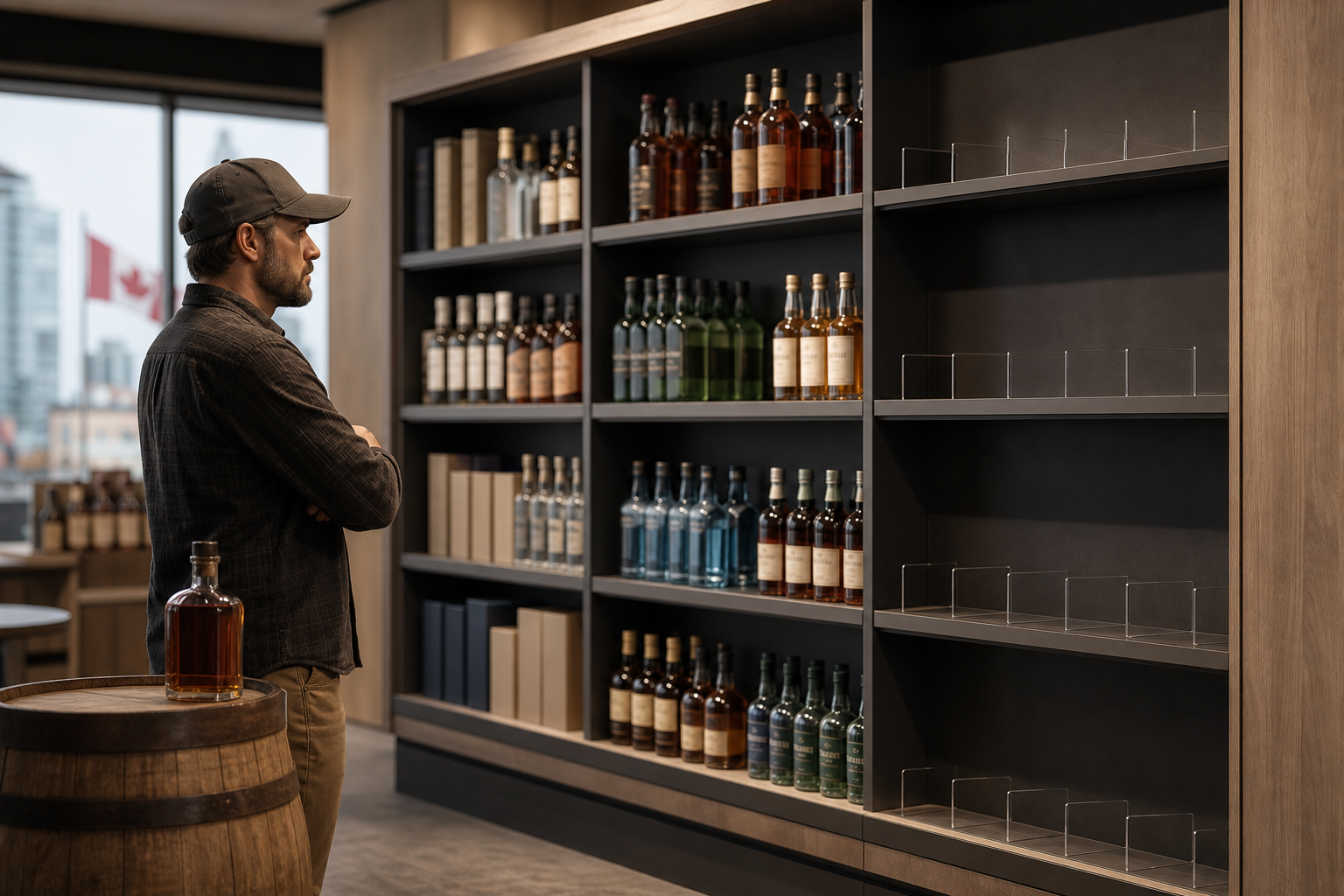

In October 2024, a craft distiller in Louisville watched his Canadian distributor drop two of his bourbon labels from provincial liquor boards. The tariffs hadn't even taken effect yet. The distributor just wanted shelf space for products with a clearer price trajectory.
That's the actual Canada problem for U.S. alcohol producers: not the tariffs themselves, but the structural displacement they set in motion before the first duty gets collected. Canada buys roughly $452 million worth of American spirits annually, making it the largest export market for bourbon and Tennessee whiskey. When those products become 25% more expensive at retail, the gap doesn't stay empty. It fills with Scotch, Canadian whisky, or Japanese imports that don't carry the same political baggage.
Why shelf space doesn't come back
Provincial liquor monopolies in Canada operate on allocation models. A distillery that loses its spot on the LCBO's "core listing" doesn't automatically get it back when trade conditions normalize. The buyer has already moved inventory, reset the planogram, and signed contracts with replacement suppliers. Reclaiming that allocation means displacing someone else, which requires either a price concession or proof of sustained consumer demand that survived the tariff period.
American whiskey producers went through this exact sequence during the 2018 steel and aluminum dispute. When the EU imposed retaliatory tariffs on bourbon, U.S. exports to Europe dropped 13% in the first year. Some of that volume returned after the dispute ended in 2021, but the revenue never fully recovered. Brands that had been growing 8-10% annually in Germany and France were suddenly fighting to hold flat three years later.
The difference with Canada is proximity. European buyers treat American whiskey as a luxury import. Canadian buyers, especially in border provinces, treat it as a category anchor. Bars in Toronto and Vancouver stock bourbon the way bars in Chicago stock tequila: not as a premium pour, but as a everyday option at multiple price points. Losing that baseline presence means losing the structural access that makes Canadian distribution worth the logistics cost in the first place.
The craft distilling ceiling
Large producers like Brown-Forman and Diageo can absorb tariff-driven margin compression for several quarters. They have diversified portfolios, global distribution networks, and balance sheets that let them wait out trade disputes. A craft operation in Kentucky or Tennessee that does $4 million in annual revenue and sends 18% of its output to Canada cannot.
The arithmetic is straightforward. A 25% tariff on a product with a 22% gross margin after production costs and U.S. distribution doesn't leave room to split the difference with the importer. Someone eats the full cost, and it's usually the producer. The alternative is raising the retail price and losing the sale entirely, which is functionally the same outcome.
That ceiling matters because the U.S. craft spirits sector added roughly 600 distilleries between 2010 and 2025, many of them built on the assumption that export growth would offset flattening domestic demand for premium brown spirits. Canada was the natural first export market: English-speaking, geographically adjacent, with distribution infrastructure that doesn't require the same regulatory burden as breaking into the EU or Asia-Pacific.
The margin that was never there
Even without tariffs, the U.S.-Canada alcohol trade runs on thin economics. The three-tier system in the U.S. compounds costs at every layer. By the time a $40 wholesale bourbon reaches a consumer in Ontario, the producer has already accepted a per-bottle margin in the low single digits. Adding a 25% duty eliminates that margin entirely, even if the tariff itself is temporary.
What doesn't reverse is the reputational damage to price positioning. A bourbon that jumped from $52 to $67 on the shelf and then dropped back to $54 eighteen months later isn't perceived as "back to normal." It's perceived as a brand that had a pricing problem. Consumers in that segment have long memories for volatility.
The Louisville distiller is still shipping to Canada, smaller volumes, different buyers. He's bidding for new export markets in Australia and Japan. But the core distributor relationship that took four years to build is gone, and the replacement math doesn't work yet.
Read Next
Northeastern PA or the Big City: What the Same Budget Buys in Each
7 Co-Ownership Agreements That Protect Both the Friendship and the Equity
The 2027 Housing Recovery in Canada Runs Through Business Investment
A Small Cut to 0.9% Growth Points to Canada's Longer Problem