Independent writing on tax-smart planning, mortgage strategy, and retirement building. For Canadian professionals who want the whole picture, not just a piece of it.
Ohio's Canada Trade Under Pressure: How Tariffs Disrupt $18 Billion in Annual Exports
A single auto part crosses the Ohio-Canada border six or seven times before the final vehicle is assembled. That's not trade in the textbook sense, two countries swapping finished goods. It's a production line that happens to cross an international boundary. When you put a 25% tariff on steel and aluminum in that system, you're not protecting Ohio jobs. You're taxing Ohio's factory floor.
Since Trump's second-term tariffs took effect in 2025, Ohio businesses and consumers have absorbed an estimated $4 billion in higher costs and lost purchasing power. The state exports roughly $18.3 billion in goods to Canada annually, and Canada is Ohio's number one export market. Ohio's exports to Canada support a significant share of the state's workforce, according to U.S. Census Bureau and Department of Commerce figures. The arithmetic is stark: you cannot shut down half your conveyor belt and call it economic nationalism.
The border-as-factory problem
Ohio and Ontario don't trade the way Brazil and Germany trade. They share what economists call a "just-in-time" manufacturing loop, especially in automotive and aerospace. A component machined in Toledo ships to a supplier in Windsor, gets assembled into a subassembly, comes back to Dayton for final integration, and crosses again for quality testing. The whole system runs on the assumption that the border functions like a county line.
Reciprocal tariffs break that assumption. A steel input that cost an Akron manufacturer roughly $1,200 per ton in early 2025 has increased substantially after duties. The manufacturer doesn't absorb that. It flows downstream into the price of machinery, consumer goods, and the component costs of every other Ohio factory that uses that part. The inflationary pressure shows up in grocery bills and car loans months later, long after the tariff headline fades.
Manufacturing accounts for roughly 16.5% of Ohio's GDP, and much of that base is concentrated in sectors where input costs matter more than brand loyalty or product differentiation. You can't pass a 20% cost spike to a buyer who has six other qualified vendors. You eat it, you cut elsewhere, or you lose the contract.
The political paradox nobody mentions
Ohio voters in 2024 supported the candidate who promised to get tough on trade. That's not irrational if you believe the problem is offshoring to low-wage countries. But Canada isn't Vietnam. Canadian wages are comparable. Canadian environmental and labor standards are comparable. The "threat" Canada poses to Ohio is that it's better at certain manufacturing steps and worse at others, and the two economies figured that out decades ago.
The policy justification relies on national security: domestic steel and aluminum production must be protected as a defense imperative. Fine. But Ohio's primary metal sector employs fewer than 30,000 people. The downstream manufacturers who use that metal employ far more workers than primary metal production. Protecting the 30,000 by raising costs for the 600,000 is the kind of arithmetic that works in a think tank and fails in a balance sheet.
What Ohio is discovering is that "buy American" sounds better than it budgets. Canada responded with its own domestic preference rules, locking Ohio firms out of construction and bridge projects in Ontario and Quebec that they used to win on cost. The retaliation isn't symbolic. It's revenue that went to someone else.
The 2026 freeze
The United States-Mexico-Canada Agreement comes up for mandatory review in 2026. That review was supposed to be routine. It's now a geopolitical cudgel. Companies that would normally invest in new capacity in Ohio are delaying because they don't know what tariff regime will be in place eighteen months from now.
Call it regulatory vertigo. The problem isn't that businesses can't plan for higher costs. They can. The problem is they can't plan when the costs might double, disappear, or invert depending on which direction a negotiation breaks.
Ohio's exports to Canada have historically supported a quarter-million jobs. The friction since 2025 hasn't killed those jobs yet. But investment that would have created the next 50,000 is sitting on hold, and every quarter that passes makes it easier to site that capacity somewhere the rules hold still.


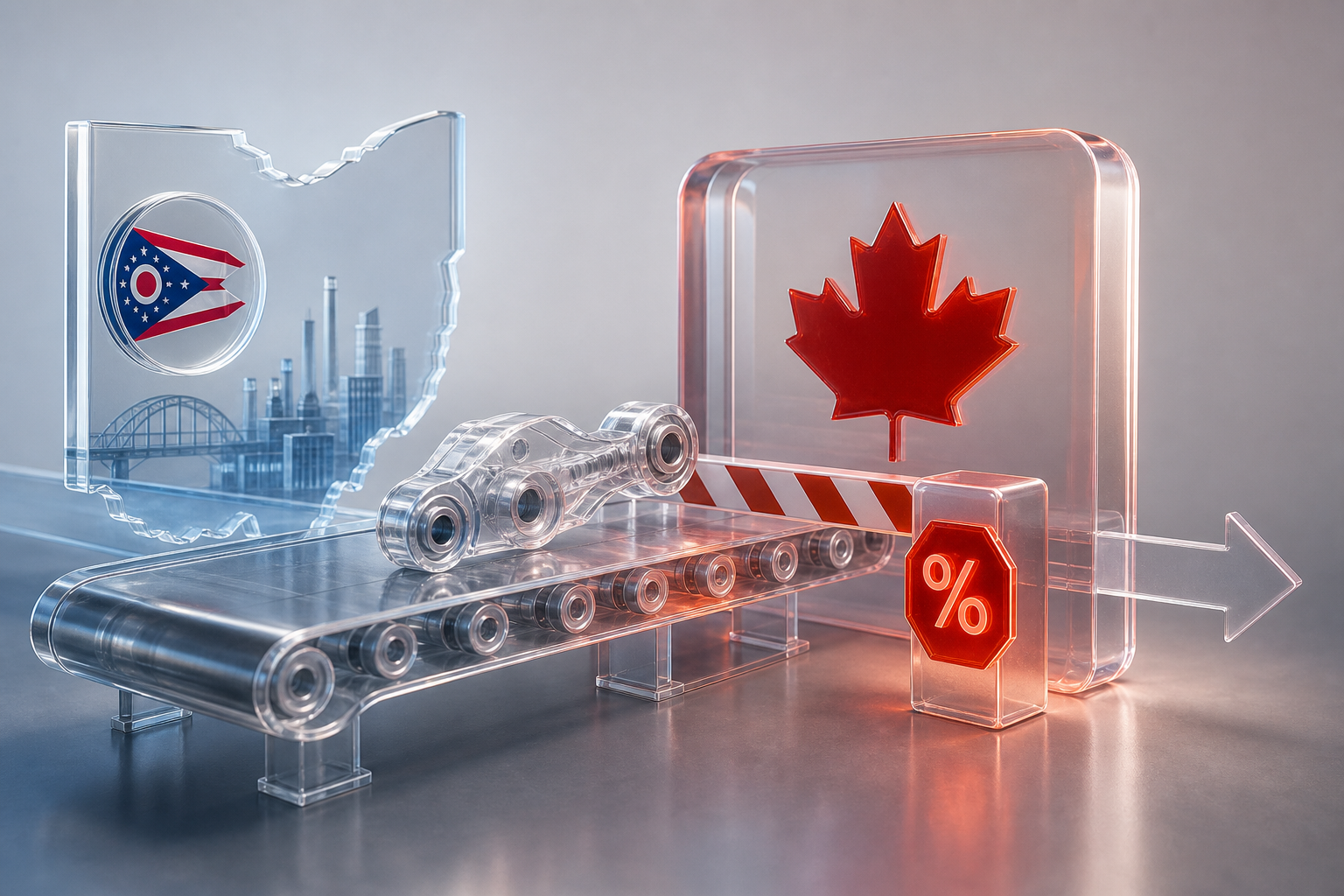

A single auto part crosses the Ohio-Canada border six or seven times before the final vehicle is assembled. That's not trade in the textbook sense, two countries swapping finished goods. It's a production line that happens to cross an international boundary. When you put a 25% tariff on steel and aluminum in that system, you're not protecting Ohio jobs. You're taxing Ohio's factory floor.
Since Trump's second-term tariffs took effect in 2025, Ohio businesses and consumers have absorbed an estimated $4 billion in higher costs and lost purchasing power. The state exports roughly $18.3 billion in goods to Canada annually, and Canada is Ohio's number one export market. Ohio's exports to Canada support a significant share of the state's workforce, according to U.S. Census Bureau and Department of Commerce figures. The arithmetic is stark: you cannot shut down half your conveyor belt and call it economic nationalism.
The border-as-factory problem
Ohio and Ontario don't trade the way Brazil and Germany trade. They share what economists call a "just-in-time" manufacturing loop, especially in automotive and aerospace. A component machined in Toledo ships to a supplier in Windsor, gets assembled into a subassembly, comes back to Dayton for final integration, and crosses again for quality testing. The whole system runs on the assumption that the border functions like a county line.
Reciprocal tariffs break that assumption. A steel input that cost an Akron manufacturer roughly $1,200 per ton in early 2025 has increased substantially after duties. The manufacturer doesn't absorb that. It flows downstream into the price of machinery, consumer goods, and the component costs of every other Ohio factory that uses that part. The inflationary pressure shows up in grocery bills and car loans months later, long after the tariff headline fades.
Manufacturing accounts for roughly 16.5% of Ohio's GDP, and much of that base is concentrated in sectors where input costs matter more than brand loyalty or product differentiation. You can't pass a 20% cost spike to a buyer who has six other qualified vendors. You eat it, you cut elsewhere, or you lose the contract.
The political paradox nobody mentions
Ohio voters in 2024 supported the candidate who promised to get tough on trade. That's not irrational if you believe the problem is offshoring to low-wage countries. But Canada isn't Vietnam. Canadian wages are comparable. Canadian environmental and labor standards are comparable. The "threat" Canada poses to Ohio is that it's better at certain manufacturing steps and worse at others, and the two economies figured that out decades ago.
The policy justification relies on national security: domestic steel and aluminum production must be protected as a defense imperative. Fine. But Ohio's primary metal sector employs fewer than 30,000 people. The downstream manufacturers who use that metal employ far more workers than primary metal production. Protecting the 30,000 by raising costs for the 600,000 is the kind of arithmetic that works in a think tank and fails in a balance sheet.
What Ohio is discovering is that "buy American" sounds better than it budgets. Canada responded with its own domestic preference rules, locking Ohio firms out of construction and bridge projects in Ontario and Quebec that they used to win on cost. The retaliation isn't symbolic. It's revenue that went to someone else.
The 2026 freeze
The United States-Mexico-Canada Agreement comes up for mandatory review in 2026. That review was supposed to be routine. It's now a geopolitical cudgel. Companies that would normally invest in new capacity in Ohio are delaying because they don't know what tariff regime will be in place eighteen months from now.
Call it regulatory vertigo. The problem isn't that businesses can't plan for higher costs. They can. The problem is they can't plan when the costs might double, disappear, or invert depending on which direction a negotiation breaks.
Ohio's exports to Canada have historically supported a quarter-million jobs. The friction since 2025 hasn't killed those jobs yet. But investment that would have created the next 50,000 is sitting on hold, and every quarter that passes makes it easier to site that capacity somewhere the rules hold still.
Sources
Read Next
Three CREA Downgrades in One Year Should Retire the 'Temporary Dip' Theory
Mortgage-Free in Retirement? The 4 Costs Your Home Still Charges You
Higher Rates, Softer Hiring: What 2026's Housing Shift Means for Your Equity
The Toronto Penthouse Premium: What Holds Value and What Is Just Status