Independent writing on tax-smart planning, mortgage strategy, and retirement building. For Canadian professionals who want the whole picture, not just a piece of it.
How rental income from a secondary suite adds $70,000 in Ontario mortgage qualifying room
A one-bedroom basement suite in Mississauga renting for $1,600 a month covers roughly $370,000 worth of mortgage qualifying room. That's purchasing power added the day you apply.
Ontario lenders use rental income to qualify you for a larger mortgage than your personal income alone would support. The mechanism is straightforward: lenders add 50% to 100% of projected rental income (depending on the institution and whether you have a signed lease) to your gross annual income before calculating your debt service ratios. A buyer earning $90,000 with $1,600 monthly rental income gets treated like a $99,600 or $109,200 earner, which changes the size of the mortgage they can carry.
The catch is the suite must be legal under the Ontario Building Code before most lenders will count it. That means ceiling height of at least 6'5" (1.95 m), proper fire separation between units, and egress windows sized to Building Code minimums. An illegal suite adds zero qualifying power. The lender orders an appraisal, the appraiser flags the suite as non-compliant, and the income disappears from your application.
What counts as rental income for qualifying
Lenders require either a signed lease or a Market Rent Appraisal, a document the appraiser produces that states the going rate for comparable units in the area. If you're buying a house with an existing tenant, the lease is proof. If the suite is vacant or you're converting space, the appraisal establishes the income number.
The percentage of rental income the lender uses varies. CMHC-insured mortgages (high-ratio loans with less than 20% down) typically allow 50% of the gross rental income to count toward qualifying. Conventional mortgages (20% down or more) are lender-specific but often follow similar rules. Check with your broker before assuming a number.
The math on a $700,000 purchase looks like this. A buyer with $90,000 personal income and no rental income qualifies for roughly $450,000 in mortgage (at a 5.25% stress test rate, assuming no other debts). Add $1,600 monthly rental income at 50% inclusion, and the same buyer now qualifies for about $520,000. The suite added $70,000 in borrowing capacity, which in this scenario is the difference between buying a $590,000 house and a $660,000 one.
The tax side is less clean
Rental income from a secondary suite is taxable. The CRA expects you to report it, and the offset is that you can deduct a proportional share of your home expenses. If the suite is 1,000 square feet in a 2,500 square foot house, 40% of your mortgage interest, property taxes, insurance, utilities, and maintenance costs become deductible. The deduction does not cover the full tax owing on the rental income.
The Principal Residence Exemption creates a larger trap. Converting part of your home into a rental suite can trigger a "partial change in use," which limits the amount of your home's appreciation that qualifies for the tax-free PRE when you sell. The CRA does not automatically apply this if the suite is a small portion of the home and you do not claim capital cost allowance (depreciation) on the structure. But if you make significant structural changes or deduct CCA, you risk losing PRE on that portion of the home's gain. Get advice before filing.
The landlord risk is real
Ontario's Landlord and Tenant Board currently has a multi-month backlog. A tenant who stops paying can take six months or longer to evict, during which time the homeowner still carries the full mortgage payment while the rental income stops.
Before you count on rental income to afford a house, price in three months of vacancy or non-payment as downside. If you cannot carry the mortgage without the suite's income, the risk is high.


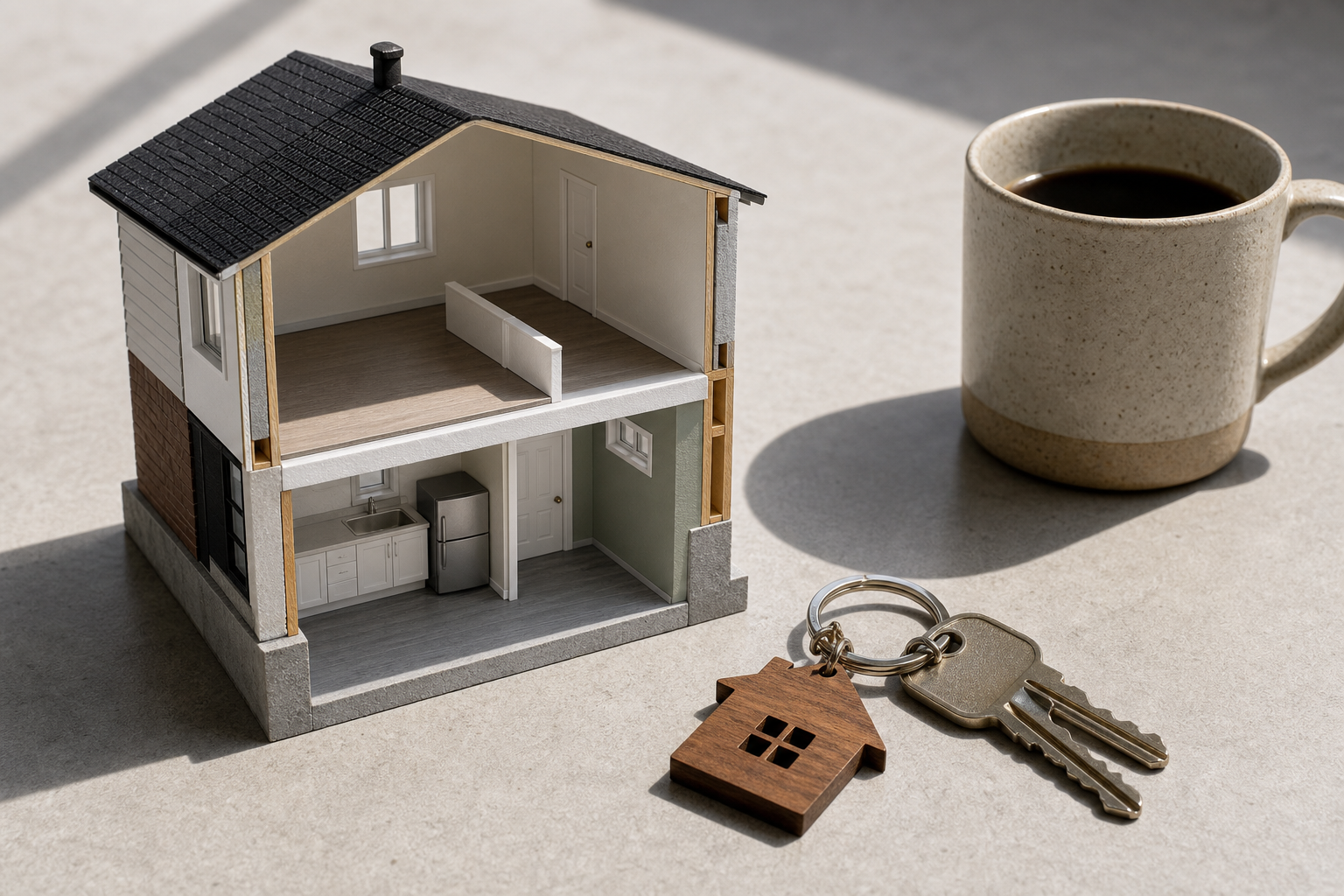

A one-bedroom basement suite in Mississauga renting for $1,600 a month covers roughly $370,000 worth of mortgage qualifying room. That's purchasing power added the day you apply.
Ontario lenders use rental income to qualify you for a larger mortgage than your personal income alone would support. The mechanism is straightforward: lenders add 50% to 100% of projected rental income (depending on the institution and whether you have a signed lease) to your gross annual income before calculating your debt service ratios. A buyer earning $90,000 with $1,600 monthly rental income gets treated like a $99,600 or $109,200 earner, which changes the size of the mortgage they can carry.
The catch is the suite must be legal under the Ontario Building Code before most lenders will count it. That means ceiling height of at least 6'5" (1.95 m), proper fire separation between units, and egress windows sized to Building Code minimums. An illegal suite adds zero qualifying power. The lender orders an appraisal, the appraiser flags the suite as non-compliant, and the income disappears from your application.
What counts as rental income for qualifying
Lenders require either a signed lease or a Market Rent Appraisal, a document the appraiser produces that states the going rate for comparable units in the area. If you're buying a house with an existing tenant, the lease is proof. If the suite is vacant or you're converting space, the appraisal establishes the income number.
The percentage of rental income the lender uses varies. CMHC-insured mortgages (high-ratio loans with less than 20% down) typically allow 50% of the gross rental income to count toward qualifying. Conventional mortgages (20% down or more) are lender-specific but often follow similar rules. Check with your broker before assuming a number.
The math on a $700,000 purchase looks like this. A buyer with $90,000 personal income and no rental income qualifies for roughly $450,000 in mortgage (at a 5.25% stress test rate, assuming no other debts). Add $1,600 monthly rental income at 50% inclusion, and the same buyer now qualifies for about $520,000. The suite added $70,000 in borrowing capacity, which in this scenario is the difference between buying a $590,000 house and a $660,000 one.
The tax side is less clean
Rental income from a secondary suite is taxable. The CRA expects you to report it, and the offset is that you can deduct a proportional share of your home expenses. If the suite is 1,000 square feet in a 2,500 square foot house, 40% of your mortgage interest, property taxes, insurance, utilities, and maintenance costs become deductible. The deduction does not cover the full tax owing on the rental income.
The Principal Residence Exemption creates a larger trap. Converting part of your home into a rental suite can trigger a "partial change in use," which limits the amount of your home's appreciation that qualifies for the tax-free PRE when you sell. The CRA does not automatically apply this if the suite is a small portion of the home and you do not claim capital cost allowance (depreciation) on the structure. But if you make significant structural changes or deduct CCA, you risk losing PRE on that portion of the home's gain. Get advice before filing.
The landlord risk is real
Ontario's Landlord and Tenant Board currently has a multi-month backlog. A tenant who stops paying can take six months or longer to evict, during which time the homeowner still carries the full mortgage payment while the rental income stops.
Before you count on rental income to afford a house, price in three months of vacancy or non-payment as downside. If you cannot carry the mortgage without the suite's income, the risk is high.
Sources
Read Next
Ottawa Already Holds the Income Data That Could Curb Mortgage Fraud
Ferries, Septic and Storm Insurance: What a Vancouver Island Cottage Really Costs Yearly
Six Bulk Buyers Took 339 Toronto Condos at 40% Off: Their Risk Checklist
If Cleveland-Cliffs Can Break Its Stelco Pledges, Every Foreign Buyer Will