Independent writing on tax-smart planning, mortgage strategy, and retirement building. For Canadian professionals who want the whole picture, not just a piece of it.
A $23.5 Million Forest Hill Sale Just Proved Toronto's Ultra-Prime Market Runs on Different Rules
A detached estate on Dunvegan Road changed hands for $23.5 million last week, $1.5 million over its asking price. That figure makes it the highest recorded residential transaction in Toronto since early 2022, when the city's detached market hit its pre-correction peak. The address sits in Forest Hill South, where lot sizes run large and proximity to Upper Canada College and Bishop Strachan School puts households within walking distance of two of the city's most expensive private schools.
The premium matters less for the dollar amount than for what it signals about market structure. This wasn't a patient negotiation or a compromise struck after months on the market. Multiple offers pushed the final price past $23 million in a bracket where most sellers right now are relieved to hit their list number. While the broader Toronto market has spent 2026 grinding through inventory overhang and higher borrowing costs, the $20 million-plus segment just ran a bidding war.
The Liquidity Divide
Mortgage stress tests don't govern transactions at this level. The Bank of Canada's policy rate, currently at 2.25%, shapes what a household earning $200,000 can borrow for a $1.2 million semi in Etobicoke. Generational wealth and liquid capital operate differently: a $23 million estate in a neighbourhood where public listings are rare and most high-value sales close off-market trades on a separate calculus entirely.
At this level, the buyer pool for a Dunvegan Road property isn't comparing mortgage payments. They're comparing the after-tax return on holding $20 million in equities, which have spent the last eighteen months whipsawing through volatility, against owning a tangible asset in a supply-constrained micro-market where comparable inventory almost never hits MLS. When the alternative is watching a portfolio fluctuate, a bidding war over a Forest Hill trophy home starts to look rational.
Scarcity as the Real Price Floor
Toronto's luxury market isn't struggling because demand collapsed. It's struggling because exceptional product is thin. The Dunvegan sale proves the capital is ready. What's missing is the inventory.
Forest Hill South, Rosedale, and the Bridle Path all operate on the same constraint: large lots, established trees, architectural significance, and school proximity create a product that cannot be replicated. You can build another condo tower at King and Spadina. You cannot manufacture another half-acre lot two blocks from UCC. When one of those properties comes to market in move-in condition, the scarcity premium overrides whatever the headline interest rate happens to be.
The contrast with the rest of the GTA is sharp. CREA reported a 5.3% year-over-year decline in national home sales as of July 2026, and Ontario's MLS Home Price Index dropped 3.9% over the same period. Detached homes across the broader region are sitting longer and selling closer to list. But within specific enclaves where the product is genuinely irreplaceable, the math doesn't follow the aggregate trend.
Why the Outlier Matters
One $23.5 million sale does not mean Toronto's luxury market is roaring back. Transaction volume in the $10 million-plus category remains well below its 2021 peak, and most sellers at this tier are still waiting months to close. The Dunvegan property is the exception.
But exceptions reveal structure. The fact that a near-record price came with multiple offers, in a year when the broader market is cooling, shows that Toronto's ultra-prime segment operates on different terms from everyday real estate. It runs on scarcity, liquidity, and a buyer pool that treats trophy homes as safe-haven assets rather than leveraged bets. The $23.5 million figure is an outlier, but the competitive urgency that produced it reflects how this market actually moves.


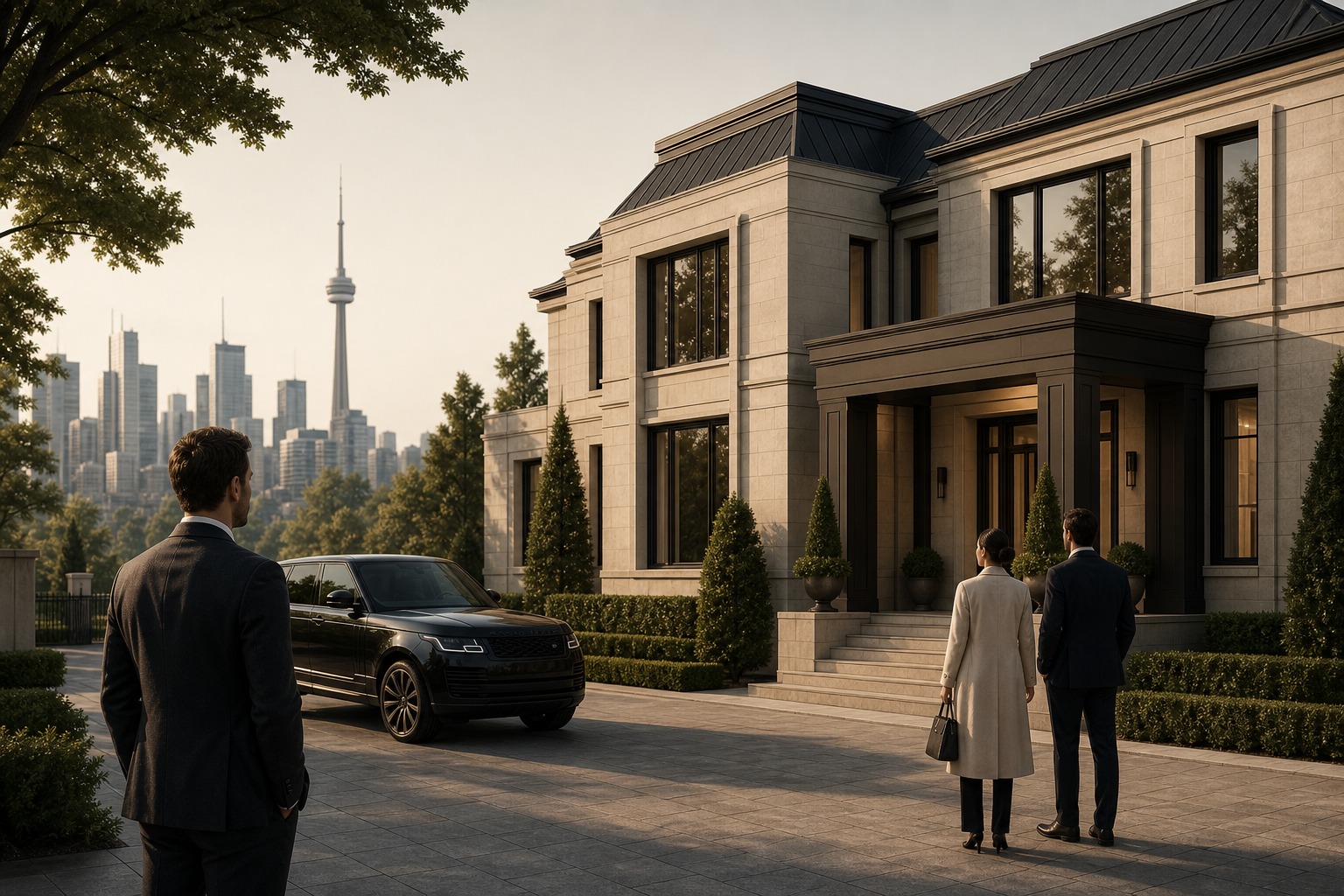

A detached estate on Dunvegan Road changed hands for $23.5 million last week, $1.5 million over its asking price. That figure makes it the highest recorded residential transaction in Toronto since early 2022, when the city's detached market hit its pre-correction peak. The address sits in Forest Hill South, where lot sizes run large and proximity to Upper Canada College and Bishop Strachan School puts households within walking distance of two of the city's most expensive private schools.
The premium matters less for the dollar amount than for what it signals about market structure. This wasn't a patient negotiation or a compromise struck after months on the market. Multiple offers pushed the final price past $23 million in a bracket where most sellers right now are relieved to hit their list number. While the broader Toronto market has spent 2026 grinding through inventory overhang and higher borrowing costs, the $20 million-plus segment just ran a bidding war.
The Liquidity Divide
Mortgage stress tests don't govern transactions at this level. The Bank of Canada's policy rate, currently at 2.25%, shapes what a household earning $200,000 can borrow for a $1.2 million semi in Etobicoke. Generational wealth and liquid capital operate differently: a $23 million estate in a neighbourhood where public listings are rare and most high-value sales close off-market trades on a separate calculus entirely.
At this level, the buyer pool for a Dunvegan Road property isn't comparing mortgage payments. They're comparing the after-tax return on holding $20 million in equities, which have spent the last eighteen months whipsawing through volatility, against owning a tangible asset in a supply-constrained micro-market where comparable inventory almost never hits MLS. When the alternative is watching a portfolio fluctuate, a bidding war over a Forest Hill trophy home starts to look rational.
Scarcity as the Real Price Floor
Toronto's luxury market isn't struggling because demand collapsed. It's struggling because exceptional product is thin. The Dunvegan sale proves the capital is ready. What's missing is the inventory.
Forest Hill South, Rosedale, and the Bridle Path all operate on the same constraint: large lots, established trees, architectural significance, and school proximity create a product that cannot be replicated. You can build another condo tower at King and Spadina. You cannot manufacture another half-acre lot two blocks from UCC. When one of those properties comes to market in move-in condition, the scarcity premium overrides whatever the headline interest rate happens to be.
The contrast with the rest of the GTA is sharp. CREA reported a 5.3% year-over-year decline in national home sales as of July 2026, and Ontario's MLS Home Price Index dropped 3.9% over the same period. Detached homes across the broader region are sitting longer and selling closer to list. But within specific enclaves where the product is genuinely irreplaceable, the math doesn't follow the aggregate trend.
Why the Outlier Matters
One $23.5 million sale does not mean Toronto's luxury market is roaring back. Transaction volume in the $10 million-plus category remains well below its 2021 peak, and most sellers at this tier are still waiting months to close. The Dunvegan property is the exception.
But exceptions reveal structure. The fact that a near-record price came with multiple offers, in a year when the broader market is cooling, shows that Toronto's ultra-prime segment operates on different terms from everyday real estate. It runs on scarcity, liquidity, and a buyer pool that treats trophy homes as safe-haven assets rather than leveraged bets. The $23.5 million figure is an outlier, but the competitive urgency that produced it reflects how this market actually moves.
Sources
Read Next
Three CREA Downgrades in One Year Should Retire the 'Temporary Dip' Theory
Mortgage-Free in Retirement? The 4 Costs Your Home Still Charges You
Higher Rates, Softer Hiring: What 2026's Housing Shift Means for Your Equity
The Toronto Penthouse Premium: What Holds Value and What Is Just Status