Independent writing on tax-smart planning, mortgage strategy, and retirement building. For Canadian professionals who want the whole picture, not just a piece of it.
5 Exterior Upgrades That Add More Value Than They Cost
A pressure washer rented for $95 and eight hours of work removed seventeen years of dirt from a two-storey stucco in Transcona, and the listing photos pulled 43% more clicks than the identical model three doors down that hadn't been washed. The sellers got asking in six days. The neighbour sat for nine weeks.
You don't recover 100% of your renovation spend because buyers aren't paying you back for your taste. You recover 100% to 200% on specific exterior fixes because those fixes remove friction from the buyer's imagination. Clean lines, working hardware, and a path that doesn't feel like a liability let them picture themselves living there instead of fixing it.
Here's what actually moves the number in Winnipeg's 2026 market, ordered by return per dollar spent.
1. Pressure wash everything vertical and horizontal
The siding, the driveway, the walkway, the porch deck. Dirt reads as deferred maintenance even when the structure underneath is sound. A buyer scrolling listings on their phone will skip a house with grey-streaked stucco or a driveway stained black from seventeen Manitoba winters because the brain codes them as "someone didn't care."
Rent a 3000 PSI gas unit from Home Depot for $95/day (2026 rate). Start at the roofline and work down. Use a 25-degree nozzle on siding, a 15-degree on concrete. Budget six to ten hours for a full exterior depending on square footage. The return isn't from adding something new. It's from letting the buyer see what's actually there.
2. Replace or repaint the front door in a high-contrast colour
The door is the only part of the exterior every single person looks at in every single photo. A faded builder-beige door against beige stucco has no focal point. A matte black or deep forest green door on the same house creates a $40,000-looking entry for the cost of a quart of exterior paint.
If the door itself is damaged (split panels, warped frame, failed weatherstripping), replace it. A steel insulated 36-inch door runs $400 to $900 installed depending on whether you're matching an unusual size. Painting a sound door costs $60 in materials if you do it yourself. Use exterior-grade paint rated to -30°C. Sand, prime, two coats. The upgrade moves listing photos from "another beige box" to "the one with the good door."
3. Install LED path lighting along the walkway
In Winnipeg, the sun sets before 5 PM from November through February. A house photographed or shown during those months with no exterior lighting looks vacant or unsafe. Path lights solve two problems: they make the approach feel intentional in photos, and they address the security concern buyers won't say out loud but will act on.
A six-fixture solar LED kit runs $120 to $180. Hardwired low-voltage systems (12V transformer, six fixtures, buried wire) cost $250 to $400 installed and perform better in deep cold. The fixtures themselves matter less than spacing: one every 8 to 10 feet from the sidewalk to the door, alternating sides. Buyers don't consciously register good path lighting. They register its absence as a reason to keep scrolling.
4. Frame the entry with matching planters
Symmetry codes as expensive even when it isn't. Two identical black fibreglass planters flanking a front door create a formal, high-end look for $90 (two 16-inch planters, potting mix, and two identical evergreens or ornamental grasses).
Use planters that are roughly one-third the width of the door. Fill them with something that holds shape year-round: boxwood, blue spruce, or fountain grass. Avoid annuals unless you're listing in June or July. The planters themselves do the work. The plants just keep them from looking empty.
5. Edge and mulch existing beds, then stop
Fresh mulch makes beds look maintained without committing to perennials a buyer might not want. A three-inch layer of dark brown hardwood mulch (not red, not blonde) costs $35 per cubic yard. Most front yards need one to two yards. Edge the beds with a half-moon edger to create a clean separation from the lawn.
Stop there. Don't plant new perennials. Don't add decorative rock. The buyer is looking at the bones of the house, not your vision for the garden.


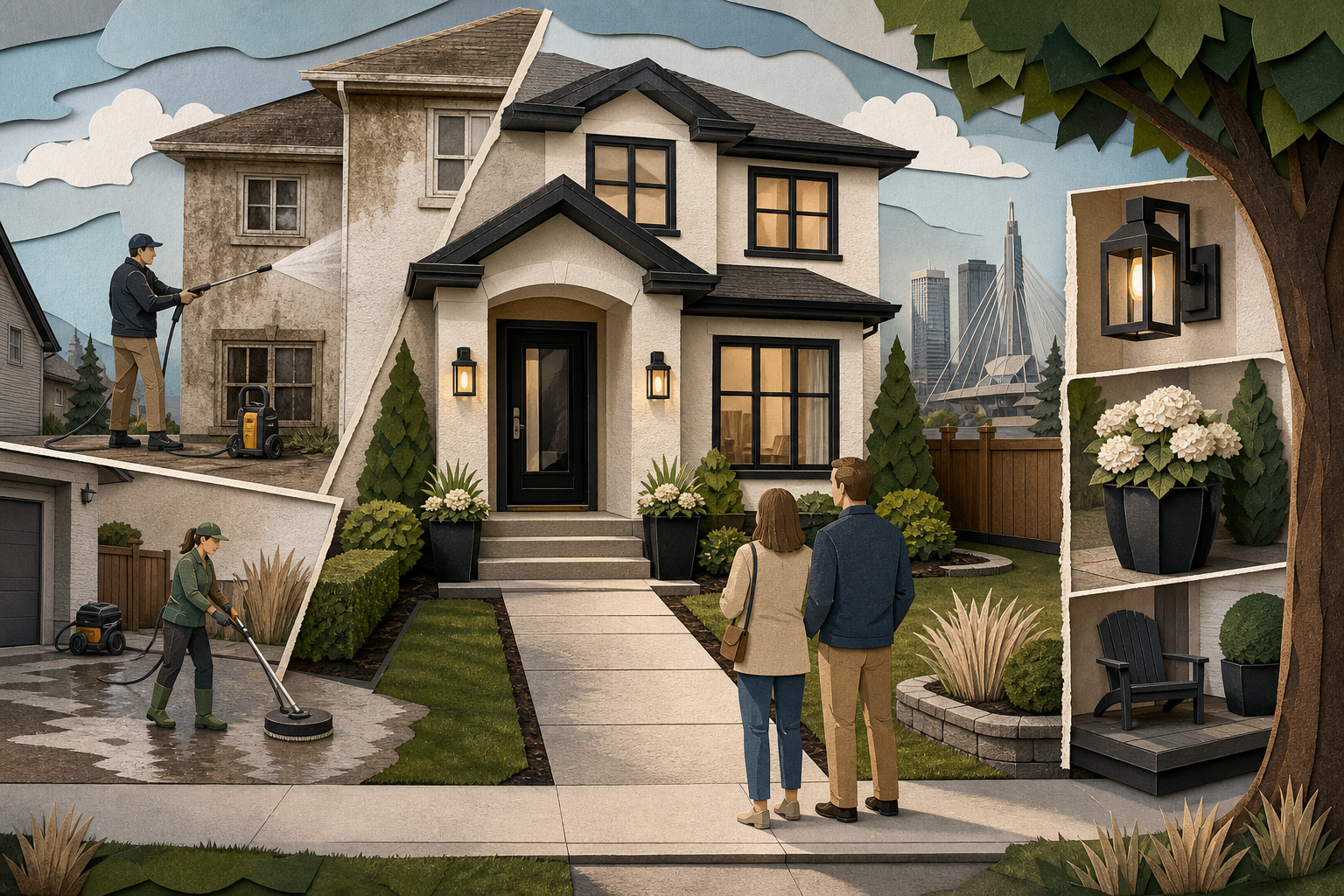

A pressure washer rented for $95 and eight hours of work removed seventeen years of dirt from a two-storey stucco in Transcona, and the listing photos pulled 43% more clicks than the identical model three doors down that hadn't been washed. The sellers got asking in six days. The neighbour sat for nine weeks.
You don't recover 100% of your renovation spend because buyers aren't paying you back for your taste. You recover 100% to 200% on specific exterior fixes because those fixes remove friction from the buyer's imagination. Clean lines, working hardware, and a path that doesn't feel like a liability let them picture themselves living there instead of fixing it.
Here's what actually moves the number in Winnipeg's 2026 market, ordered by return per dollar spent.
1. Pressure wash everything vertical and horizontal
The siding, the driveway, the walkway, the porch deck. Dirt reads as deferred maintenance even when the structure underneath is sound. A buyer scrolling listings on their phone will skip a house with grey-streaked stucco or a driveway stained black from seventeen Manitoba winters because the brain codes them as "someone didn't care."
Rent a 3000 PSI gas unit from Home Depot for $95/day (2026 rate). Start at the roofline and work down. Use a 25-degree nozzle on siding, a 15-degree on concrete. Budget six to ten hours for a full exterior depending on square footage. The return isn't from adding something new. It's from letting the buyer see what's actually there.
2. Replace or repaint the front door in a high-contrast colour
The door is the only part of the exterior every single person looks at in every single photo. A faded builder-beige door against beige stucco has no focal point. A matte black or deep forest green door on the same house creates a $40,000-looking entry for the cost of a quart of exterior paint.
If the door itself is damaged (split panels, warped frame, failed weatherstripping), replace it. A steel insulated 36-inch door runs $400 to $900 installed depending on whether you're matching an unusual size. Painting a sound door costs $60 in materials if you do it yourself. Use exterior-grade paint rated to -30°C. Sand, prime, two coats. The upgrade moves listing photos from "another beige box" to "the one with the good door."
3. Install LED path lighting along the walkway
In Winnipeg, the sun sets before 5 PM from November through February. A house photographed or shown during those months with no exterior lighting looks vacant or unsafe. Path lights solve two problems: they make the approach feel intentional in photos, and they address the security concern buyers won't say out loud but will act on.
A six-fixture solar LED kit runs $120 to $180. Hardwired low-voltage systems (12V transformer, six fixtures, buried wire) cost $250 to $400 installed and perform better in deep cold. The fixtures themselves matter less than spacing: one every 8 to 10 feet from the sidewalk to the door, alternating sides. Buyers don't consciously register good path lighting. They register its absence as a reason to keep scrolling.
4. Frame the entry with matching planters
Symmetry codes as expensive even when it isn't. Two identical black fibreglass planters flanking a front door create a formal, high-end look for $90 (two 16-inch planters, potting mix, and two identical evergreens or ornamental grasses).
Use planters that are roughly one-third the width of the door. Fill them with something that holds shape year-round: boxwood, blue spruce, or fountain grass. Avoid annuals unless you're listing in June or July. The planters themselves do the work. The plants just keep them from looking empty.
5. Edge and mulch existing beds, then stop
Fresh mulch makes beds look maintained without committing to perennials a buyer might not want. A three-inch layer of dark brown hardwood mulch (not red, not blonde) costs $35 per cubic yard. Most front yards need one to two yards. Edge the beds with a half-moon edger to create a clean separation from the lawn.
Stop there. Don't plant new perennials. Don't add decorative rock. The buyer is looking at the bones of the house, not your vision for the garden.
Sources
Read Next
Three CREA Downgrades in One Year Should Retire the 'Temporary Dip' Theory
Mortgage-Free in Retirement? The 4 Costs Your Home Still Charges You
Higher Rates, Softer Hiring: What 2026's Housing Shift Means for Your Equity
The Toronto Penthouse Premium: What Holds Value and What Is Just Status