Independent writing on tax-smart planning, mortgage strategy, and retirement building. For Canadian professionals who want the whole picture, not just a piece of it.
25 States Sue Over Trump Tariffs, Arguing the President Cannot Tax Without Congress
California, New York, Illinois, and twenty-two other states filed suit in federal court this week against tariffs the Trump administration imposed in late July on a range of imported raw materials and finished goods. The rates run from 10% to 25% depending on the category. The complaint argues something most trade disputes avoid saying plainly: that the President lacks constitutional authority to impose what the states are calling a national tax without legislative approval.
The lawsuit turns on two federal statutes, Section 232 of the Trade Expansion Act of 1962 and Section 301 of the Trade Act of 1974, both of which grant the executive branch discretion to impose tariffs in response to threats to national security or unfair trade practices. The states are not disputing that those statutes exist. They are arguing that Congress, in writing them, handed over a power it never had the right to delegate in the first place.
The Constitutional Claim
Article I, Section 8 of the Constitution assigns the power to levy taxes and regulate commerce to the legislative branch. The states' brief frames tariffs not as foreign policy tools but as revenue measures that raise the cost of goods for American consumers and businesses. The distinction matters because courts have historically deferred to the President on national security grounds, but taxation is different legal terrain. If the tariffs function as a broad-based consumption tax, and the complaint includes projections showing they will generate tens of billions in federal revenue, then Congress must authorize them explicitly, not through a six-decade-old blanket delegation.
The administration's expected defense will lean on the "national security" justification embedded in Section 232, which allows the President to restrict imports when they threaten defense capabilities or critical infrastructure. Previous challenges to Section 232 actions, including a 2020 case involving steel tariffs, ended with courts siding with executive discretion. But this coalition is betting that a more targeted argument, focused on taxation rather than trade policy, will find a different reception, especially with appellate benches that have shown increasing skepticism of broad agency and executive power.
Why States Are the Plaintiffs
The states are claiming direct injury, not abstract harm. Their budgets include large capital projects, highway expansions, bridge retrofits, renewable energy installations, that depend on imported steel, aluminum, and specialized components not yet produced at competitive scale domestically. The complaint cites cost overruns already surfacing in Washington State's transit projects and California's grid modernization work. When tariffs raise input costs by 15% or more, state transportation and energy budgets absorb the difference or delay projects, both of which give the states standing to sue.
This is the same litigation strategy Democratic attorneys general deployed repeatedly during the first Trump term and that Republican attorneys general used during the Biden administration. The pattern is now well established: states function as a national opposition party when Congress is gridlocked or aligned with the administration. It allows a coalition of governors and attorneys general to stall or block federal policy through the courts without needing a single vote in Washington.
What Happens If They Win
A ruling in favor of the states would not eliminate tariffs. It would require Congress to pass legislation explicitly authorizing them, converting what is now an executive decision into a legislative one. That is a higher bar politically, because a tariff bill forces individual members to vote on the record for higher consumer prices, something most prefer to avoid.
The case will likely take months to reach a preliminary hearing, and years if it moves through appeals. Courts tend to move slowly when the underlying question is separation of powers. In the meantime, the tariffs remain in effect, the costs continue to compound, and the states collect evidence of financial harm to strengthen their case at each stage.


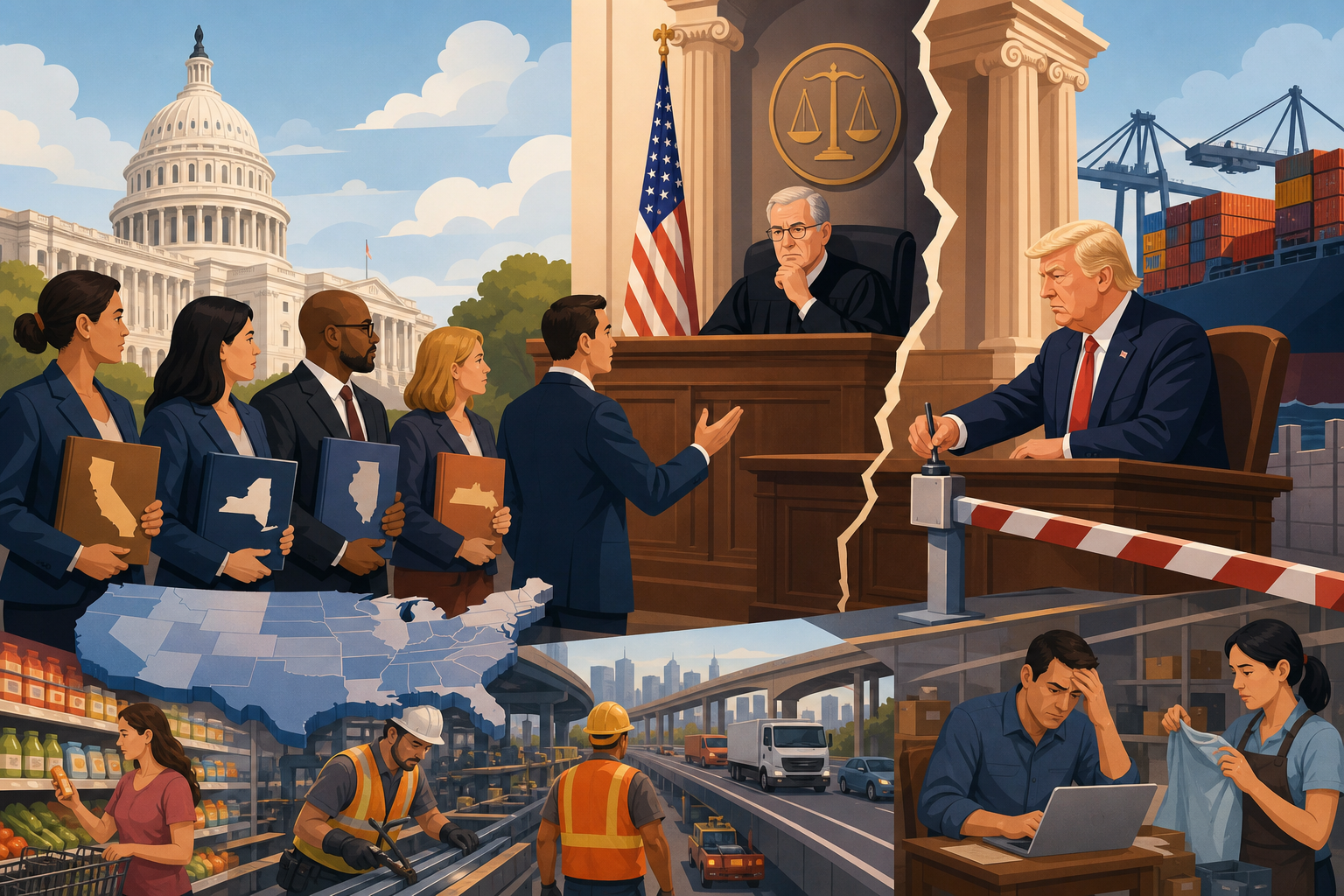

California, New York, Illinois, and twenty-two other states filed suit in federal court this week against tariffs the Trump administration imposed in late July on a range of imported raw materials and finished goods. The rates run from 10% to 25% depending on the category. The complaint argues something most trade disputes avoid saying plainly: that the President lacks constitutional authority to impose what the states are calling a national tax without legislative approval.
The lawsuit turns on two federal statutes, Section 232 of the Trade Expansion Act of 1962 and Section 301 of the Trade Act of 1974, both of which grant the executive branch discretion to impose tariffs in response to threats to national security or unfair trade practices. The states are not disputing that those statutes exist. They are arguing that Congress, in writing them, handed over a power it never had the right to delegate in the first place.
The Constitutional Claim
Article I, Section 8 of the Constitution assigns the power to levy taxes and regulate commerce to the legislative branch. The states' brief frames tariffs not as foreign policy tools but as revenue measures that raise the cost of goods for American consumers and businesses. The distinction matters because courts have historically deferred to the President on national security grounds, but taxation is different legal terrain. If the tariffs function as a broad-based consumption tax, and the complaint includes projections showing they will generate tens of billions in federal revenue, then Congress must authorize them explicitly, not through a six-decade-old blanket delegation.
The administration's expected defense will lean on the "national security" justification embedded in Section 232, which allows the President to restrict imports when they threaten defense capabilities or critical infrastructure. Previous challenges to Section 232 actions, including a 2020 case involving steel tariffs, ended with courts siding with executive discretion. But this coalition is betting that a more targeted argument, focused on taxation rather than trade policy, will find a different reception, especially with appellate benches that have shown increasing skepticism of broad agency and executive power.
Why States Are the Plaintiffs
The states are claiming direct injury, not abstract harm. Their budgets include large capital projects, highway expansions, bridge retrofits, renewable energy installations, that depend on imported steel, aluminum, and specialized components not yet produced at competitive scale domestically. The complaint cites cost overruns already surfacing in Washington State's transit projects and California's grid modernization work. When tariffs raise input costs by 15% or more, state transportation and energy budgets absorb the difference or delay projects, both of which give the states standing to sue.
This is the same litigation strategy Democratic attorneys general deployed repeatedly during the first Trump term and that Republican attorneys general used during the Biden administration. The pattern is now well established: states function as a national opposition party when Congress is gridlocked or aligned with the administration. It allows a coalition of governors and attorneys general to stall or block federal policy through the courts without needing a single vote in Washington.
What Happens If They Win
A ruling in favor of the states would not eliminate tariffs. It would require Congress to pass legislation explicitly authorizing them, converting what is now an executive decision into a legislative one. That is a higher bar politically, because a tariff bill forces individual members to vote on the record for higher consumer prices, something most prefer to avoid.
The case will likely take months to reach a preliminary hearing, and years if it moves through appeals. Courts tend to move slowly when the underlying question is separation of powers. In the meantime, the tariffs remain in effect, the costs continue to compound, and the states collect evidence of financial harm to strengthen their case at each stage.
Read Next
Northeastern PA or the Big City: What the Same Budget Buys in Each
7 Co-Ownership Agreements That Protect Both the Friendship and the Equity
The 2027 Housing Recovery in Canada Runs Through Business Investment
A Small Cut to 0.9% Growth Points to Canada's Longer Problem